
Predictive content analytics: How to find ideas that actually work

Most content ideas are still picked five minutes before publishing – from a competitor’s viral clip, an old topic, or a random “let’s try this.” That is why so many posts fail. Virale helps replace guessing with predictive content analytics: it looks at audience signals, niche patterns, and past performance to show which ideas are more likely to resonate before you create.
Predictive content analytics connects data science with everyday creative work. Instead of relying on luck, your brand gets a repeatable way to choose topics, angles, and hooks that match what your audience is already responding to. Salesforce notes that AI can analyze historical audience data – including demographics, interests, and behaviors – to predict which people are most likely to engage with specific content or campaign goals.
Why the “post and pray” approach stopped working
The real problem isn’t that teams aren’t trying hard enough. They pour energy in, build polished carousels and reels, then watch a post hit 200 views and fade. Guessing at topics wears people down faster than the editing ever does.

Compare it to paid media. Nobody launches a paid campaign blind: it starts with tests, numbers, and hypotheses. Organic content, on the other hand, usually runs on a feeling: “I think our audience will love this.” When the algorithm updates or a niche gets saturated with the same topic, that feeling fails you, and reach (how many people actually saw the post) drops along with the team’s morale.
Then burnout sets in. Someone pitches ten topics, nine flop, and by the eleventh they’re out of both ideas and faith. That’s what algorithmic fatigue looks like: the team loses its sense of direction. When nobody knows what will work, every new idea feels equally risky, so the team either copies someone else or recycles old material. This is exactly the kind of creative variance that good ROI-driven ideation is supposed to mitigate, and guesswork makes it worse.
“We went through thousands of accounts and saw one simple thing: what burns people out isn’t the volume of work, it’s not understanding why one post took off and ten similar ones didn’t. Remove that uncertainty and motivation comes back within a couple of weeks.”
– Dima Torgov, founder of ChatPlace
When you eliminate guesswork in social media, you free up not only time, but also mental space. The team stops arguing blind and starts working with topics that have at least some grounding behind them.
Read also: A month of content in 15 minutes: How AI ended our content-calendar grind
How to find ideas with a real shot, not just pretty topics

A strong post idea sits at the intersection of three things: what your audience cares about right now, what you can show better than anyone, and what competitors haven’t already worn out. Keep all three in mind and finding ideas stops being a creative struggle and becomes a clear, repeatable task. Let’s walk through where to look for the signals that point to a topic.
The first source is your own data. Pull up your posts from the last three months and find the ones that took off for no obvious reason. There’s almost always a recurring angle hiding there: a specific pain point, a format, or a tone. Real audience interest sits behind those wins, and it’s worth building on.
The second source is your DMs and comments. People tell you flat out what they care about: they ask the same questions, complain about the same struggles. Every repeated question is a ready-made post topic, with built-in interest, because real people already asked for it.
The third source is movement in your niche. Which topics are picking up steam with similar creators, and which ones everyone is already sick of. The trick is to catch a topic on the way up, instead of jumping on a trend after the format has already burned out.
Sorting through all of this by hand takes forever, and that’s where machine learning trend synthesis earns its keep. Virale continuously tracks how your past posts performed, watches local and global shifts in your niche, and parses the semantic clusters of incoming DMs. From those signals the AI builds a list of high-yield topic clusters before you’ve written a single line of script. That’s Virale AI content forecasting in practice: high-yield topic selection done before production, not after.

Virale is part of the ChatPlace ecosystem. ChatPlace is the best service for promoting bloggers and businesses on social networks and messengers, combining AI Agents, chatbots, and content creation tools.
Getting Started: Step-by-Step
Sign up for ChatPlace and connect your Instagram account. Virale auto-analyzes your content, stats, and audience.
- Open Virale (the eye icon in your dashboard sidebar).
- Choose your workflow: suggest a topic, paste a link, send a text, or record a voice note.
- Answer the agent’s quick questions: slide count, style, CTA.
- Review the carousel. Edit any slide with text or voice commands.
- Download your slides, copy the generated caption, and publish.
Works on desktop and mobile. No code, no design skills, no technical setup.
What an audience resonance score is and how to read it
Before you publish, it helps to understand whether the idea has a real chance to work with your audience.
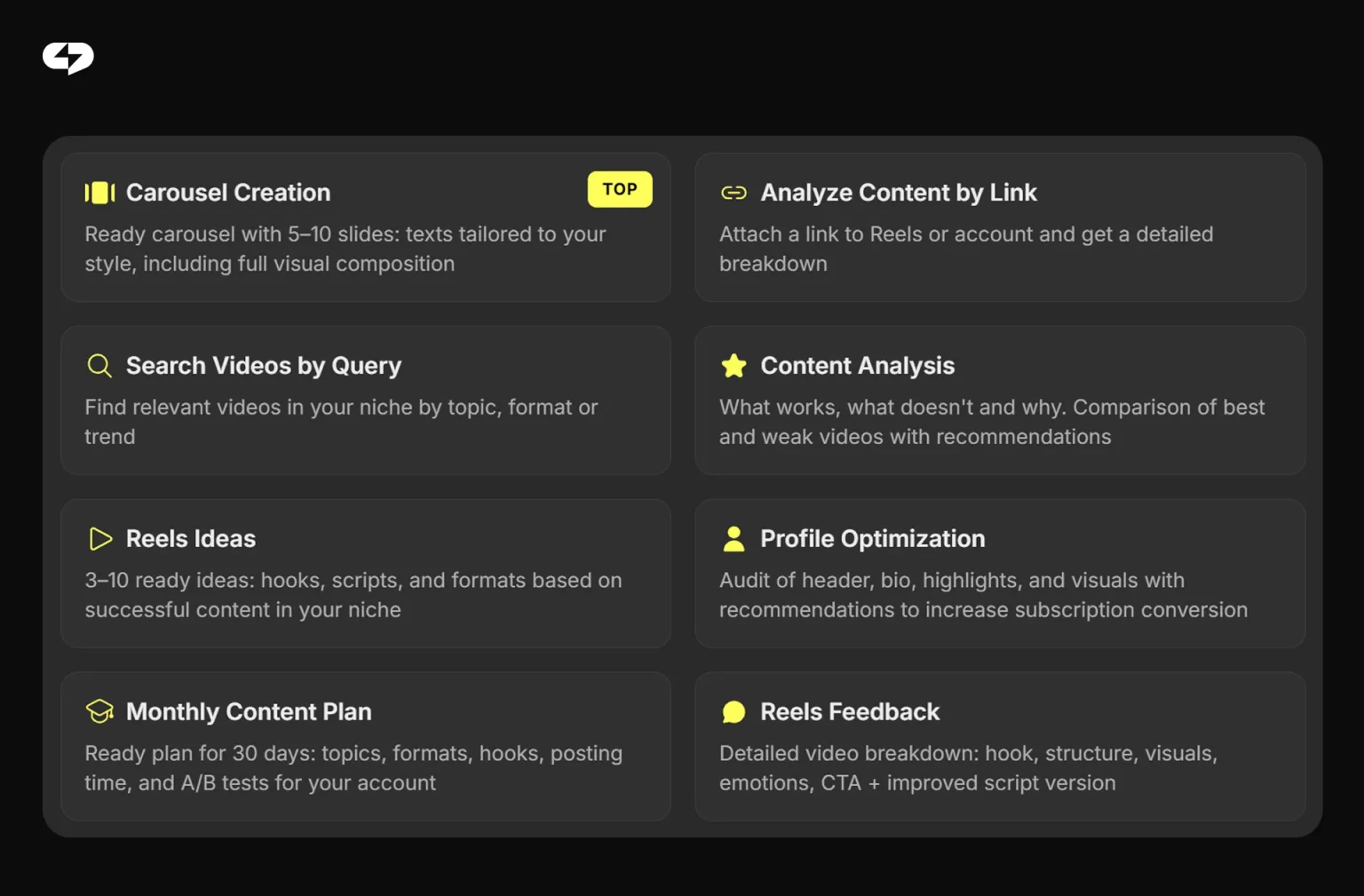
Virale looks at a few signals: how people reacted to your past content, what is gaining attention in your niche right now, and whether the topic is already overused. This does not guarantee a viral post, but it helps you avoid weak ideas before you spend time turning them into content.
Think of it like a weather forecast. It cannot promise perfect accuracy, but it is still better than walking outside with no idea whether it might rain. Content works the same way: you are not trying to predict the future perfectly, you are trying to make a smarter choice before you create.
It is also worth checking not just the topic, but the hook. The same idea can perform very differently depending on the first line or opening angle. Virale helps spot weak phrasing and suggests stronger ways to introduce the idea.
The forecasts do not need invasive tracking. They can rely on broader performance patterns, public trends, and the data your audience chooses to share with you, such as replies, comments, and anonymized DM insights.
Learn more: Stop Posting at Random – Instagram’s New AI Tells You What Your Audience Wants
What finding ideas with AI looks like

The big shift with a predictive approach is that you spend effort where it pays off. The old way poured hours into production on a hunch; the new way invests them in ideas that already have evidence behind them. Below is a side-by-side across three stages of the work, so you can see exactly how the hours get reallocated.
Read down each row and mark where your team is today. Odds are you’ll recognize yourself in the left column on at least one stage.
| Stage of work | The legacy intuition-based model | The predictive analytics model |
| 1. Ideation and planning | A two-hour team meeting arguing over which topic “feels right,” or trying to copy last month’s viral video. | The dashboard auto-generates a list of high-yield topic clusters mapped to real-time audience resonance data. |
| 2. Risk management | Scripts and designs built blind, hoping the algorithm picks them up after posting. | Hooks and openers run through a pre-production simulation before you film: the AI flags weak angles and predicts a performance score. |
| 3. Execution and scaling | Hours of manual asset building with zero guarantee of an organic return. | The highest-scoring ideas convert straight into a production-ready 10-slide carousel or a Reels script blueprint. |
As you can see, the point isn’t to work more. The hours simply move off guessing and onto picking topics with clear potential, which takes a huge chunk of stress off the team.
How to fit idea selection into your week
The simplest place to start is setting a resonance threshold and refusing to produce anything below it. That alone settles half the debates: if a topic doesn’t clear the bar, it doesn’t get made, no hurt feelings and no drawn-out meetings. From there the whole thing turns into a short weekly ritual instead of a two-hour brainstorm.
That clean path from signal to post is the data-to-creative pipeline: raw response data turns into live carousels and Reels scripts without losing meaning along the way. You see what landed before, what your DMs are buzzing about, and what’s rising in your niche, and what comes out the other side is a ready idea with a format suggestion attached, not a dry report. In 2026, that short hop from data to post is what separates teams that grow predictably from everyone else.
Find content ideas with the Virale AI Creator

Finding ideas stops being a lottery once every topic has something behind it: data about your audience, movement in your niche, and an honest read on saturation. Predictive content analytics won’t do the work for you, but it removes the most expensive risk of all, which is pouring effort into an idea that was never going to land. Your team spends its time on what’s likely to work and stops burning out on constant guesswork.
Stop leaving your brand’s growth to chance. Move your social operation from creative guesswork to predictive precision.
FAQ
What is predictive content analytics in plain English?
It’s a way to gauge whether an idea will land with your audience before you’ve filmed a reel or built a carousel. The system inside Virale looks at your past posts, follower behavior, and niche trends, then outputs a likely-response score. The higher the score, the lower the risk of spending time on a weak topic.
How does Virale AI content forecasting work, and how accurate is it?
The system continuously analyzes your post history, shifts in your niche, and the meaning behind incoming messages, then assigns each topic a resonance score. It’s a probability forecast, much like a weather report, with no promise of a guaranteed viral hit. It filters out the obviously weak ideas and shows you which hook has the most upside.
What’s the best tool to eliminate guesswork in social media for a business?
Predictive analytics tools like Virale are built for exactly this. They show which topics are most likely to work for your audience and turn the strong ones into ready carousels and Reels scripts. That makes your data-driven content marketing manageable and grounded in real numbers instead of gut feeling.
Is it safe from a data and privacy standpoint?
Yes. The forecasts are built on macro performance metrics, public trends, and your own opt-in data that followers consented to share, such as anonymized DM logs. There’s no user surveillance and there are no tracking cookies, so the approach stays transparent and compliant with international privacy standards.
How do I start shifting from intuition to data?
Set a minimum resonance score that ideas have to clear before they go into production, and run your hooks and openers through the forecast before you film. Begin by auditing your last three months of posts and the questions that keep coming up in your DMs, because the ready-made topics are already there. From there, idea selection becomes a short weekly routine instead of a long argument.

Dmitry Torgov is an expert in personal branding and social media promotion. Co-founder of ChatPlace.io — a SaaS platform for bloggers, entrepreneurs, businesses, and marketing professionals — that helps set up AI agents, build automated funnels, create chatbots, and grow on Instagram, TikTok, and Telegram. Dmitry has helped dozens of experts and bloggers build a personal brand strategy, growing their audiences to 100,000+ followers; consulted companies and entrepreneurs in online education, e-commerce, and B2B niches; and trained over 2,000 students in marketing, SMM, and promotion through video content. “Personal branding is not about views, likes, or quick hype. Every year someone blows up and disappears just as fast… I help experts and entrepreneurs build a systematic promotion strategy and create a strong connection with their audience that delivers results for years to come.”