
AI Agent for Online Course Creators: Automating Course Launches and Sales in 2026
Most EdTech and online course businesses lose revenue at two critical stages of the funnel. Before the sale – due to slow response times, missed inquiries, and unprocessed leads. After the purchase – because of weak onboarding, low engagement, and poor student lifetime value (LTV).
According to recent industry benchmarks, the average response time to an inbound lead still exceeds 40 hours. At the same time, contacting a prospect within the first few minutes increases qualification and conversion rates multiple times.
On the retention side, many online courses underestimate the cost of neglecting existing students. Without structured onboarding, ongoing support, upsells, and community building, churn increases. This means that teams have to keep buying new traffic and spending more on ads to make up for it.
The real solution is funnel automation across the entire student journey
Modern EdTech growth is no longer about hiring more sales or support staff. It’s about making key parts of the funnel automatic:
- inbound lead processing;
- 24/7 communication;
- student onboarding and support;
- retention and LTV growth;
- scalable operations without increasing payroll.
This is where AI Agents and chatbots come in. They take broken processes and turn them into a system that qualifies leads, sells courses on autopilot, helps students, and answers most common questions – without burning out your team.
Learn more: Meet the new AI Agent from ChatPlace: how it works and why it’s a game-changer for your business
In this article, we’ll cover:
- which sales funnels work best for online course creators in 2026;
- how to use AI Agents and chatbots at both the sales and retention;
- which automation and gamification mechanics drive higher LTV and retention;
- how to implement all of this without developers or complex infrastructure.
Modern Sales Funnels for Online Course Creators in 2026
The classic webinar funnel – built around long warm-up sequences, mandatory “discovery calls” and aggressive closing tactics, is no longer the standard for course creators. Audiences today are faster, more skeptical, and much more aware of being manipulated. They want clarity, relevance, and immediate value.
The focus has changed to funnels that build trust first, deliver value instantly, and respect the user’s time (not fake scarcity or pseudo-diagnostics).
Value-first funnel: Content → Action → Product

The core principle of 2026 is simple: value before the sale.
One of the most effective models for platforms like Instagram and TikTok looks like this:
- Content (Reels, carousels, Stories – ideally with UGC).
- Instant value delivery (guide, template, short video) triggered by a keyword.
- Short educational message sequence with practical insights.
- Clear offer or next logical step.
All of this can run fully automatically with ChatPlace, without a sales manager, 24/7.
Why this funnel works:
- lowers resistance;
- builds trust instantly;
- avoids the “get-rich-quick” stigma.
There’s no digging into pain points, no pressure, no fake diagnostics – just relevant content and logical progression.
Instant lead magnet delivery also solves the biggest bottleneck: response speed. While competitors reply hours later, your chatbot delivers value in seconds.
Micro-products as an Entry Point to the Ecosystem
Instead of pushing flagship courses upfront, many online course creators and education businesses (EdTech) now rely on micro-products – often called tripwires – as the first paid step in the funnel.
- short mini-courses;
- hands-on workshops;
- 1-2 hour intensives;
- access to a private community.
This model is built around the idea of a “small yes.” It’s much easier for a user to make a low-risk purchase than commit immediately to a premium program.
For course creators, this approach delivers clear advantages:
- first monetization early in the funnel;
- warmer, more qualified customers;
- higher conversion into core products;
- increased LTV without aggressive selling.
AI-powered chatbots and AI Agents guide users through a natural sequence:
free value → micro-product → flagship offer, preparing the student for each next step without friction.
Community-first Funnels: Environment Before Sales

One of the most sustainable growth models for online course creators today is the community-driven funnel.
Instead of selling courses upfront, creators increasingly focus on building an environment where trust, engagement, and momentum come first – and monetization follows naturally.
More course businesses now:
- build an audience first (Slack, Discord, Telegram);
- deliver the community ongoing value;
- sell education as the next logical step.
A common structure looks like this:
- Access through content or a free resource.
- Invitation to a private group or community.
- Discussions, live sessions, and feedback from experts.
- Offer a course as the next logical step.
It gets people involved early on and makes them feel like they belong. Sales feel like support, not pressure, and social proof works better than ads.
Personalized AI Funnels Instead of Static Scripts
The new automation standard is real-time personalization.
Static scripts and one-size-fits-all funnels no longer work at scale. Modern funnels need to adapt dynamically to user behavior, intent, and experience level – in real time.
With an AI Agent, funnels adjust automatically based on context:
- beginners receive foundational paths;
- experienced users see advanced programs or upsells;
- businesses are routed to relevant B2B offers.
Instead of fixed scripts, the system reacts to user actions, questions, and experience level. This typically increases conversion rates by 20-30% compared to static funnels.
This is exactly how ChatPlace works. It combines AI Agents, chatbots, and content automation to help creators, bloggers, and businesses turn engagement in social networks and messengers into scalable revenue – without manual intervention.
The Funnel Doesn’t End at Checkout: Retention and LTV
One of the biggest mistakes online course creators make is treating the funnel as complete once payment is made. In reality, the most expensive and important – phase starts after the first purchase.
If onboarding is confusing and support is slow, motivation drops quickly. Students stop logging in, don’t complete lessons, and silently churn.
The first two weeks decide everything
Modern onboarding for online courses focuses on speed, clarity, and confidence.
Effective onboarding typically includes:
- automated welcome messages and clear navigation;
- step-by-step introduction to the learning format;
- instant answers to common questions;
- a strong feeling of “I’m not alone here”.
Support that doesn’t slow learning down
Around 70–80% of student questions are repetitive:
“Where’s the homework? When is the next live session? How do I download my certificate?”
AI Agents trained on your content can answer these instantly, 24/7.
This keeps students moving forward while freeing human support for complex or high-touch cases.
Context-aware reminders beat generic notifications
Generic messages like “Don’t forget to watch the lesson” don’t work.
What does work is context-aware automation:
- paused at lesson 3 → reminder about topic X;
- active but skipped homework → prompt to submit the practice task.
The goal is not more notifications, but timely, relevant nudges that help students progress without feeling pressured.
Community Is Part of the Product
Communities are no longer “nice-to-have.” They directly impact retention, trust, and repeat sales. Seeing peers progress, ask questions, and share wins keeps students engaged and reduces drop-off.
The key is segmentation. Smaller, course-specific groups outperform massive general chats.
Why Automation Is No Longer Optional
Everything described above requires a system, not a collection of disconnected tools.
Manual processes break at scale. At 500 or 5k students, automation stops being a marketing add-on and becomes the operational backbone of the business.
Without it, growth turns into constant hiring, burnout, and declining quality.
Automation isn’t about doing more marketing. It’s about maintaining quality, speed, and consistency as volume increases.
How ChatPlace Helps Online Course Businesses Scale
ChatPlace acts as a communication and automation infrastructure, not just another “sales bot”.
It connects every stage of the student journey into a single system:
- automated onboarding funnels;
- AI-powered student support;
- progress-based engagement and reminders;
- automated community management;
- contextual upsells inside conversations.
This allows course creators to stop losing leads before purchase and students after it – and build a sustainable education business instead of isolated launches.
AI Agents vs. Scripted Bots
Traditional scripted chatbots follow predefined flows. They work only when users behave exactly as expected – and break the moment a conversation goes off-script.
AI Agent works differently
Instead of pushing users through rigid scenarios, ChatPlace AI Agent acts as a virtual conversation manager. It:
- understands context and user intent;
- personalizes communication in real time;
- remembers conversation history;
- escalates only complex cases to human support.
As a result, an AI Agent can handle up to 80% of standard requests, dramatically reducing response times and supporting workload – without sacrificing the quality of the experience.
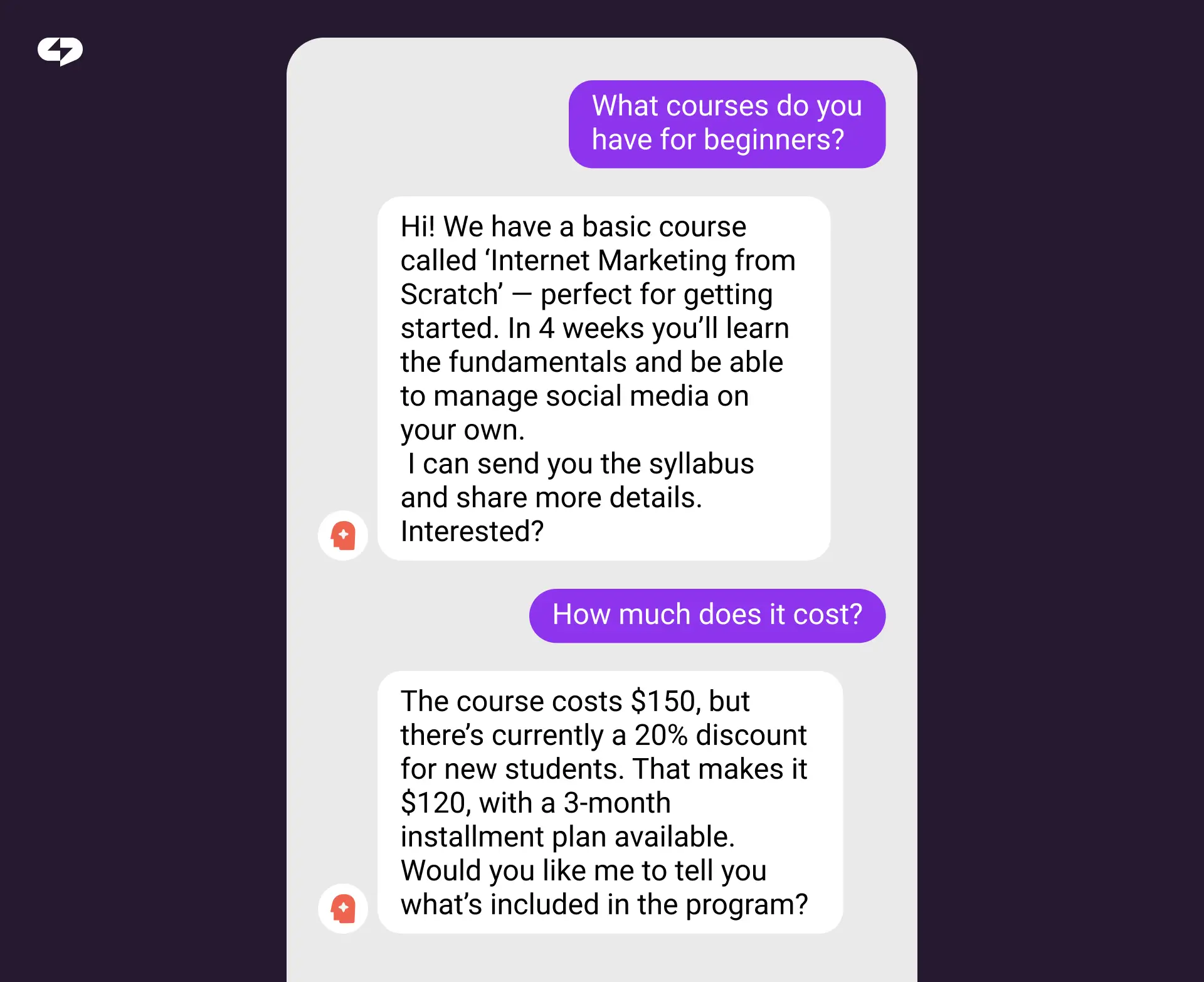
This shift turns automation from a simple FAQ layer into an adaptive system that supports sales, onboarding, and retention at scale.
Gamification: Increasing Engagement and Completion Rates
Gamification turns progress and participation into visible momentum.
Instead of relying on reminders alone, modern funnels reward meaningful actions with points and incentives, such as:
- comments and reactions;
- story mentions and UGC;
- referrals and invites;
- quizzes;
- lesson completion.
Leaderboards, bonuses, and rewards turn passive students into active participants.
The result is higher engagement, better course completion rates, and increased organic reach – without increasing ad spend.

Gamification works best when combined with AI-driven automation, where rewards and prompts are triggered by real behavior rather than fixed schedules.
Manual Launch vs Automation
To understand the real value of automation, let’s look at the key stages of a course launch. Below is a clear comparison between manual processing and an AI-powered automated system.
| Launch Stage | Manual Mode | ChatPlace |
| Lead Collection | Slow; leads get lost in DMs or scattered across CRMs | Instant via a keyword-based capture, 24/7 |
| Follow-ups & Reminders | Impossible to reach everyone manually | Automated broadcast to everyone at once |
| Payment Processing | Manual receipt checks and access handling | Payment integrations with automatic access delivery |
| Attendance Rate | Low (forgot to send the link) | High (automatic reminders and confirmations) |
| Lead Qualification | Managers waste time on cold leads | AI Agent qualifies leads automatically |
| Scaling | Requires hiring more staff | AI Agent Handles any volume without added headcount |
Automation doesn’t replace the team – it unlocks their time.
Instead of acting as manual responders, managers focus on warm leads, complex conversations, and strategic growth. Automation handles the repetitive work; humans close deals and build relationships.
ChatPlace Integrations: CRM and Payment Systems
The automation service must seamlessly fit into a course creators existing ecosystem. ChatPlace integrates with popular CRM (like Kommo) and payment systems (like Stripe or PayPal) – there’s no need to change familiar tools, simply connect the integrations.
There’s no need to rebuild workflows or switch platforms. You simply connect your integrations, and ChatPlace handles lead routing, payments, access delivery, and follow-ups automatically.
This makes it easy to add AI-powered automation on top of your current setup – without disrupting operations or retraining your team.
How to Launch a Keyword Chatbot for Your Online Course Business
You can set up a basic AI-powered funnel in 10-15 minutes, without developers or complex setup:
- Choose and create a lead magnet – a guide, checklist, or mini-lesson that solves a specific problem for your audience. A good lead magnet delivers quick results and demonstrates your expertise.
- Sign up for ChatPlace – get 14 trial days of access to all features, including the AI Agent. No credit card required.
- Connect your accounts – Instagram, Telegram, or TikTok can be connected in just a few clicks via the official API. It’s safe and fully compliant with platform rules.
- Set up a trigger – choose a keyword. For example: “BONUS”, so it activates the bot.
- Build a message flow. Something like that, welcome message → subscription check → content delivery.
- Add nurturing messages with valuable content and a soft CTA to your product. The optimal setup is about 3-5 messages with 1-2 day intervals.
- Connect a payment system – to automatically grant access after purchase.
- Launch and optimize. Track conversion rates at every stage of the funnel and optimize weak points.
ChatPlace also offers ready-made chatbot templates for course creators: webinar registration funnels, lead magnet delivery, and booking calls. You can take a template and adapt it to your needs in just a few minutes.
This is helpful: Best AI for Business in 2026: In-Depth Review & Comparison of Instagram Chatbots
AI chatbots and AI Agents are no longer the future of online education businesses – they are the present.
They make it possible to scale sales, personalize communication, and support thousands of students simultaneously without expanding headcount.
Course creators and education businesses (EdTech) teams that automate today don’t just save time – they build a durable competitive advantage that compounds over the next several years.
FAQ
What is an AI Agent for online course creators?
An AI Agent for online course creators is an automated system that processes inbound leads, sells courses, supports students, and manages communication across the entire funnel. It handles pre-sale questions, onboarding, support, and retention without manual involvement in most cases.
Does ChatPlace integrate with CRM and payment systems?
Yes. ChatPlace integrates with popular CRMs like Kommo and payment systems such as Stripe and PayPal, allowing automatic lead routing, payment processing, and access delivery.
How does faster response time affect course sales?
Contacting a prospect within the first few minutes significantly increases qualification and conversion rates. AI Agents respond instantly, delivering value while competitors are still replying manually.
What sales funnels work best for online course creators in 2026?
The most effective funnels in 2026 are value-first funnels that deliver instant value, avoid pressure tactics, and guide users logically toward a purchase. These include content-driven funnels, micro-products, and community-first models.
Is automation suitable for small course creators?
Yes. Automation is especially valuable for small teams and solo creators, allowing them to run scalable launches, support students, and grow revenue without burnout or constant hiring.
What kind of student questions can AI Agents handle?
AI Agents can answer 70-80% of repetitive student questions, such as lesson access, homework location, live session schedules, certificates, and platform navigation – instantly and 24/7.
How do AI Agents help sell courses automatically?
AI Agents guide users through automated sequences: delivering free value, presenting micro-products, answering questions, qualifying leads, and offering core programs. All interactions adapt to user behavior in real time.
How is an AI Agent different from a scripted chatbot?
Scripted chatbots follow fixed flows and break when users go off-script. AI Agents understand context, personalize responses, remember conversation history, and adapt communication dynamically, escalating only complex cases to humans.
Can AI Agents personalize funnels for different types of students?
Yes. AI Agents adjust funnels in real time based on user experience and intent. Beginners receive foundational paths, while advanced users or businesses are shown relevant advanced programs or B2B offers.
How do AI Agents improve student onboarding?
AI Agents provide automated welcome messages, explain course structure, answer common questions instantly, and help students navigate the platform confidently during the first critical weeks.

A marketer with over 10 years of experience in digital and performance marketing. Specializing in building business promotion strategies, implementing AI solutions, and marketing automation. At ChatPlace.io, he is responsible for marketing, helping entrepreneurs and creatives use AI, chatbots, auto-funnels, and gamification to grow and develop their businesses on social media.