
How to Start Selling on Instagram Without Building a Website
You have something to sell. A digital course, a yoga program, handmade candles, a coaching package, event tickets. You also have an Instagram audience that already knows and trusts you. What you do not have is three months to build a website, a paid Shopify plan, or the patience to glue together a landing page, a payment processor, and a CRM just to take your first 10 orders.
In many cases, a website adds extra steps instead of helping. Meta has shifted Shops on Facebook and Instagram to website checkout, but the part of Instagram that still helps many small businesses close sales is the conversation: DMs, comment triggers, and payment links shared right in the chat. The buyer sees the post, sends a direct message, asks the price, and pays – all in the same thread. A separate website can get in the way of a process that is already working.
This guide shows how to set up a simple sales flow on Instagram without a website, from the first Reel that catches attention to the payment link.
Skip the website and start selling online today
The default advice for years was simple: you need a website to be taken seriously, you need a cart to take payments, you need an ecommerce platform to scale. That advice assumed something that is no longer true – that the social platform is for discovery and the website is for sales.
Today, Instagram handles both. The app has a native comment-to-DM trigger and a direct message interface that buyers are already comfortable with. A website adds three things: another click, another load time, and another interface the buyer has to learn. Each of those is a step where people often drop out.
For small-scale selling – under a few hundred orders a month – a website now subtracts more than it adds. The buyer is already on Instagram. They already trust the profile they are looking at and they are one tap away from messaging you. Sending them to an external page breaks that trust and tests their patience. Cart abandonment rates on mobile web are notoriously high for exactly this reason.
A good Instagram sales funnel does not compete with a website. It replaces the website entirely for the first stretch of a business’s life.
How people go from content to purchase on Instagram
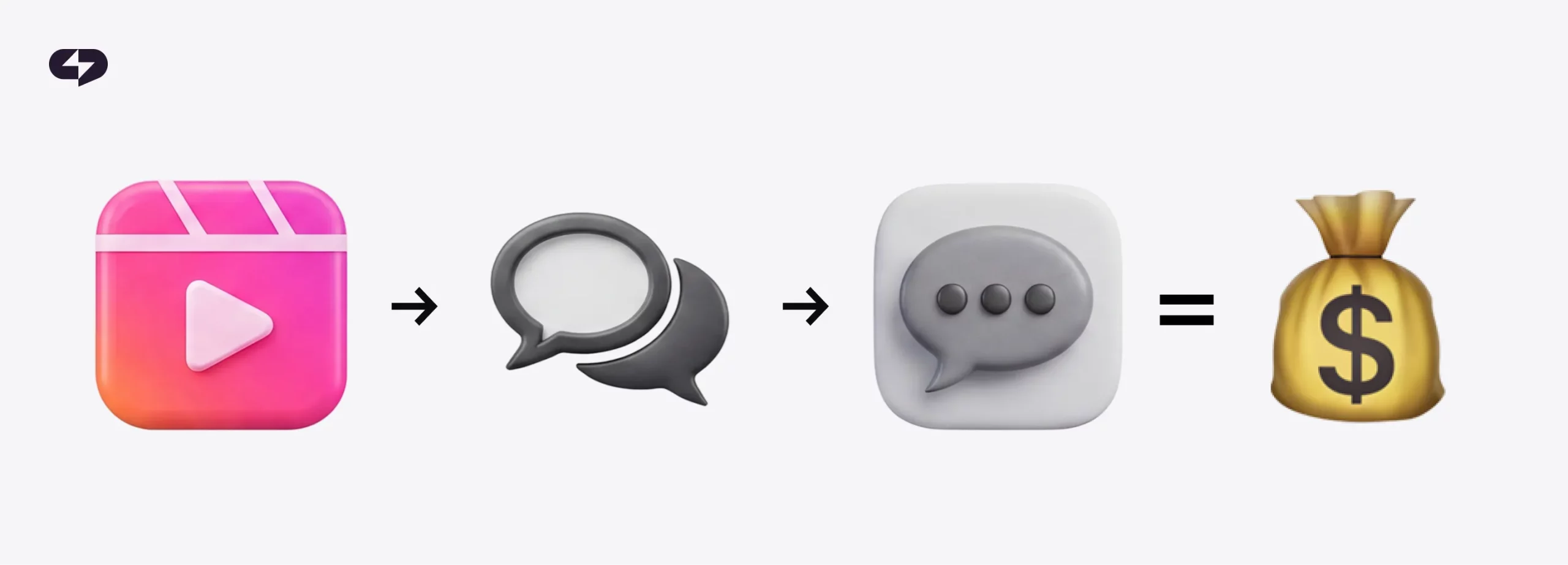
Every working Instagram funnel has four stages: first contact, interest, conversation, payment. Each stage uses a specific Instagram feature, and people often drop off when moving from one step to another.
The table shows what happens at each stage, what the buyer does next, and which Instagram feature supports that step.
| Funnel stage | What happens | Buyer action | Instagram feature |
| First contact | A new viewer finds your content | Watches a Reel or Story to the end | Reels, Stories, Explore |
| Interest | The viewer signals interest | Comments a keyword, or sends the first DM | Comment trigger, Direct Message |
| Conversation | You deliver value and qualify the lead | Answers a few quick questions in DM | Automated DM flow |
| Payment | The buyer pays or books | Taps a payment or booking link | DM payment link, calendar link |
Read the table top to bottom and you can see the shape of the funnel. A stranger sees your Reel (first contact), gets interested enough to comment a keyword (interest), walks through a short conversation that answers their real questions (conversation), and then taps a link to pay (payment).
The two points where this process usually breaks are the move from comment to DM, and the move from conversation to payment.
Read also: Best Instagram AI Agent for Business: How to Turn DMs Into Sales
The keyword trigger: How to move people from comments to direct messages
Using a keyword is one of the simplest ways to start a DM conversation. Here is how it works.
You publish a Reel or a Story with a clear call to action: “Comment the word start and I will send you the free checklist.” A viewer leaves a comment with the word. Within seconds, they receive a direct message with the checklist, a greeting, and a natural question that opens a short DM conversation.
Three things make this work. First, it turns a passive viewer into someone who has shown clear interest. Commenting a word takes very little effort. Second, it pulls the buyer out of the public comment section and into a one-on-one space where selling is natural. Third, it is trackable: every comment with the keyword can be tracked, which lets you see which content actually drives business.
The keyword you choose matters more than it looks. A good keyword is short, specific to the offer, and does not appear in regular conversation. “Start”, “guide”, “info”, “yes” all work for specific offers. Avoid using the same keyword across different posts – if three Reels all use “yes” as the trigger, you can’t tell which post drove which user.
Another useful entry point is the first DM. A viewer who opens your profile and sends a direct message with a question like “how much is the course?” or “do you still have availability?” is usually just as interested as someone commenting a keyword. A good setup handles both situations in the same way and moves them into the same DM conversation.
Buyers do not read comments for keywords the way you might imagine. They see the CTA in the video itself. If your Reel voiceover says "comment start" and the caption repeats it, comment volume tends to be 5–10x higher than if you just wrote the keyword once in the caption. The instruction has to be in the content, not hidden in a line of text below.
How the DM conversation moves toward a sale
Once the viewer is in your DMs, a short conversation can do three things: make them feel welcome, show whether the offer fits their needs, and share the payment link only when they are ready to use it.
Keep the conversation short. Four steps is usually enough. Longer and the buyer drops off. Shorter and you end up sending payment links to people who were not really going to buy.
- Greeting and value delivery. The first message says hi, thanks them for the comment, and delivers the thing you promised (the checklist, the price list, the info pack). No selling yet. This is where trust gets built.
- Interest check. Short question that confirms the buyer is thinking about the offer seriously. For a coaching package: “Are you looking for a one-off session or an ongoing programme?” For a product: “Which size were you thinking about?” The answer helps you understand what they need and keeps the next step specific.
- Budget or readiness check. Gentle confirmation that the buyer is ready to buy, not just browsing. “The programme starts next Monday – does that timing work for you?” or “The package is €350 – would that fit your budget this month?” A buyer who answers yes here is ready for the offer.
- Offer and payment link. A one-sentence summary of what they are getting, followed by the payment link. “Perfect – here’s the link to the programme, payment confirms your spot.”
Each step should live in its own message. Do not compress all four into one long DM – the buyer reads the first line and skims the rest. Short messages in sequence feel like a real conversation and pull the buyer forward one decision at a time. Try setting up your first sales funnel today:
How to wire this together without writing any code

Everything described above works if you are willing to reply manually 24/7. Nobody is. Which is why the funnel can be automated. Find out how to avoid losing potential customers on Instagram with the ChatPlace AI Agent.
ChatPlace is the best service for promoting bloggers and businesses on social networks and messengers, combining AI Agents, chatbots, and content creation tools – which means the same platform that writes your content can also run the funnel that sells from it.
Setting this up takes about an hour the first time and does not require any coding or connecting APIs manually. The steps, in order:
Connect the Instagram account. One authorisation. ChatPlace reads comments and sends DMs on behalf of the account, so the viewer sees messages coming from you, not from a bot on another platform.
Define the keyword and the trigger post. Pick the word, pick the Reel or Story it belongs to, paste the content you want the automation to deliver as the first message. The platform will react to any comment containing that word on that post within seconds.
Build the flow as a sequence of messages. Each message in the flow has a delay (a few seconds is usually right), a piece of content, and the next message depends on what the buyer says.
Paste the payment link at the end. This can be a Stripe or PayPal link. The platform sends it at the right moment in the conversation.
Test it as a buyer. Before switching it live, comment the keyword from a second account and walk through the full flow. Find the awkward phrasing, the messages that feel too long, the steps where you’d personally drop off. Fix and retest.
Once it is live, the system runs itself. You check the inbox for conversations that branched outside the flow – specific questions, special requests, the kind of thing an automation cannot handle – and everyone else walks the path automatically.
Learn more: How to Turn Instagram Views Into Followers and Paying Clients With a Lead Magnet
Start small, learn from real conversations, and improve as you go
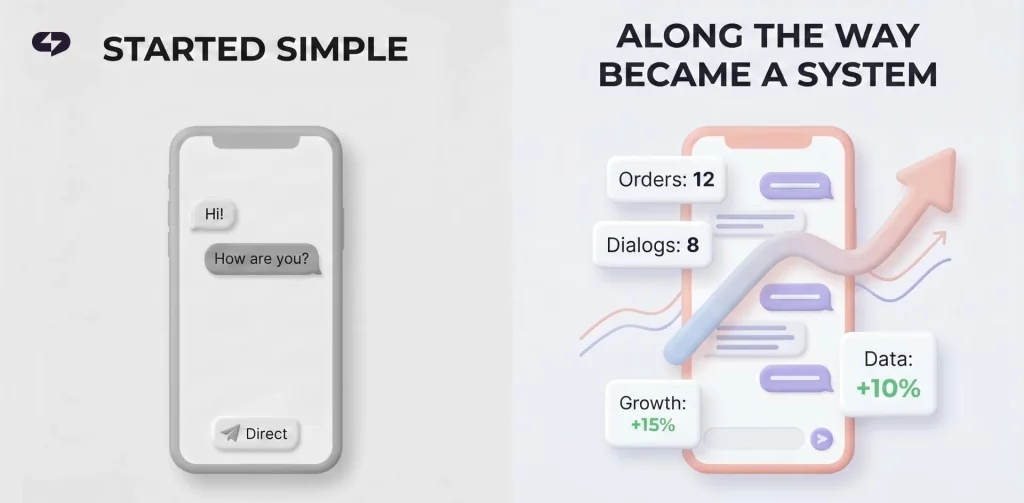
For businesses handling a few hundred orders a month or less, selling through Instagram without a website is often one of the simplest and most affordable ways to start. The tools are already there, inside the app people use every day. The goal is not to build a complex system from day one, but to make it easy for interested buyers to ask, decide, and pay.
Start with one post, one keyword, and one short message sequence. Launch it this week instead of spending months building extra infrastructure. Watch the first 20 conversations closely and notice where people pause, what they ask about, and what helps them move forward.
A 14-day free trial in ChatPlace gives you time to test the setup, see how people respond, and adjust the flow as you go:
FAQ
What is an instagram sales funnel without website, and who is it for?
An Instagram sales funnel without website is a sequence of actions – discovery on Reels or Stories, keyword trigger in comments, qualification in DMs, and payment via a link – that takes a viewer from never hearing of you to paying for your offer, all inside Instagram. It is built for creators, coaches, service providers, and small product brands who want to start selling immediately without the cost and lead time of building a separate site. Once volume crosses several hundred orders a month, a full website starts to add value, but below that threshold the in-app funnel usually converts better.
What are the best instagram dm trigger keywords to use on my posts?
Short, specific to the offer, and not something that naturally appears in the comments. “Start”, “guide”, “price”, “book”, “info”, “yes” are all usable. Avoid generic words like “interested” that people might type in normal comments. Use a different keyword for each Reel or campaign so you can track which content drives which sale. A good keyword rolls off the tongue when you say it in the Reel voiceover – if saying it feels awkward, the keyword is wrong.
How to build an instagram sales bot without any coding experience?
Use a no-code automation platform that plugs into Instagram’s official messaging API. You pick the trigger (a keyword on a specific post, or a first DM), build the message flow visually as a sequence of replies and conditions, and paste in the payment link at the end. Setup takes about an hour the first time, and no part of the process requires writing code or configuring servers.
Is social commerce automation 2026 going to replace traditional ecommerce websites?
Not entirely, but for a clear segment of businesses it already has. Small creators, service providers, coaches, and product brands under a few hundred monthly orders are moving off standalone sites and running entire funnels inside Instagram, TikTok, and WhatsApp. Larger businesses with complex inventory, multi-channel distribution, or SEO-driven traffic still benefit from a traditional site. The distinction will sharpen over the next few years as more payment and logistics features get baked into social apps.
How does a direct message sales funnel compare to landing pages in terms of conversion?
Conversion rates on DM funnels tend to be meaningfully higher than landing-page equivalents for the same audience and offer, for three reasons. The buyer never leaves the app. The conversation feels personal, not transactional. Questions can be answered in real time, which removes the objections that kill landing-page conversions. The tradeoff is scale – DM funnels work well up to a few hundred daily conversations, while a landing page can absorb unlimited traffic. Most small businesses never hit the ceiling.
Can I use a ChatPlace no-code funnel if I already have a Shopify store?
Yes, and the two pair nicely. A lot of brands run the Instagram funnel as the top-of-funnel path for audiences who found them in the app, and send the buyer to the Shopify checkout at the payment step. You get the conversational, low-friction discovery and qualification on Instagram, and the fulfillment and inventory management you already have set up in Shopify. The payment link in the DM simply points to the Shopify product page.
What happens if a buyer asks a question my automation was not set up to answer?
Good automation platforms let the conversation branch out to a human when the buyer says something that doesn’t match any of the expected replies. You get a notification, open the DM, answer the question yourself, and then resume the flow or let the buyer continue the conversation manually. Typically under 15% of conversations need human handling once the flow is tuned – everyone else goes end-to-end on autopilot.
How do I take payments in a direct message without a website?
Several options work. Stripe payment links and PayPal.me links are the simplest – you create the link once, paste it into the automation flow, and the buyer taps it to pay. For bookings, Calendly or similar booking tools generate links that hold a slot the moment the buyer confirms. For European markets, SumUp and Revolut Business also generate per-transaction links. None of these require a hosted website – they are self-contained payment pages run by the provider.

Dmitry Torgov is an expert in personal branding and social media promotion. Co-founder of ChatPlace.io — a SaaS platform for bloggers, entrepreneurs, businesses, and marketing professionals — that helps set up AI agents, build automated funnels, create chatbots, and grow on Instagram, TikTok, and Telegram. Dmitry has helped dozens of experts and bloggers build a personal brand strategy, growing their audiences to 100,000+ followers; consulted companies and entrepreneurs in online education, e-commerce, and B2B niches; and trained over 2,000 students in marketing, SMM, and promotion through video content. “Personal branding is not about views, likes, or quick hype. Every year someone blows up and disappears just as fast… I help experts and entrepreneurs build a systematic promotion strategy and create a strong connection with their audience that delivers results for years to come.”