
How to Audit Your Instagram Content and Predict Viral Posts Like a Million-Follower Blogger

You put two hours into planning a carousel. Nailed the opening, picked a topic your audience has been asking about, edited the visuals twice. It lands at 600 views. Meanwhile, a behind-the-scenes photo you posted half-asleep at 11pm pulled 8,000. You shrug, call it the algorithm, and promise yourself to “post more consistently” next week.
According to Instagram’s own creators blog, what actually matters most now is original content that holds attention – not volume. So why does this keep happening, and what can you do about it? The answer is sitting inside your own profile, waiting to be read.
Why posting more doesn’t grow your Instagram anymore
Nobody tells new creators this: posting five times a week on its own isn’t a strategy if you’re not learning from the results.
Think about what actually happens when you post on feel. You pick a topic because it felt right over coffee. You write a caption in ten minutes and publish. If it does well, you don’t really know why. If it flops, you also don’t know why. Next week you do the same thing again, hoping something sticks. After a year of this, most people have 200 posts and zero patterns they can point to.
The Instagram algorithm has shifted what it rewards. Reach (how many people see your post) used to be a volume game – post often, stay visible. Now the algorithm measures audience retention: whether the people who see your post actually watch it, save it, or share it. If most people scroll past in the first two seconds, your next post starts from a lower position.
This is why “post more” advice has stopped working. More posts don’t help if half of them are hurting you. One great post that holds attention can outperform six mediocre ones across the whole month.
A better question to ask yourself is what you actually know about which of your posts are working, and why.
Most creators can’t answer that. The data exists – it sits in Instagram Insights, post by post. The problem is that you can’t hold 50 or 100 or 300 posts in your head at once. Memory compresses everything into vague impressions like “that Reel did pretty well, I think” or “I hate that carousel, let’s not talk about it.” That kind of pattern-matching is closer to gut feeling than to real analysis.
Good news: every one of your hits has a pattern. A specific hook shape, a topic angle, an emotional trigger. Those patterns are sitting in your archive. All you need is a Reels analytics system to pull them out.
Learn from your past posts with AI
The mindset switch that changes everything is simple: every post you publish is a small experiment with a visible result.
Each time you hit publish, you tell the algorithm something about the kind of content you make. The algorithm responded – with reach, with watch time (how long people stayed before scrolling away), with saves, with shares. That response is feedback. It’s as close to a direct message from your audience as you’ll ever get.
Most creators ignore this feedback. They celebrate the wins, hide from the losses, and move on. It feels easier to post again than to ask why the last one didn’t land.
But the posts that flop are the most useful data you have.
A flop tells you one of three things. Either the topic was off for your audience. Or the hook – the first line or first visual – didn’t stop the scroll. Or the format was wrong for the idea (you made a Reel out of something that wanted to be a carousel). Usually it’s a small stack of these, not one big failure.
The hits are less informative than you think. A single viral post on its own is noise. But five hits that share a pattern – same hook shape, same topic area, same visual style – are a signal from your audience about what they actually want more of.
Read also: What to Post Next on Instagram: A Smarter Way to Plan with Virale
The shift is from “I hope this one works” to “let me check what’s been working.” It takes an afternoon, but it gives you a clearer basis for what to post next.
What to look for in your own post-performance audit
Before we talk about any tool, try doing this by hand. If you only ever run this one afternoon of analysis, you’ll already be ahead of 80% of creators.
Open your Instagram Insights. Sort your posts from the last 90 days by reach. Take the top 10 and the bottom 10. You’re going to look at four things across both groups.
- The hook. Look at the opening line of your caption and the first three seconds of your Reels. What do your winners have in common? What do your flops have in common? Most creators have a hook pattern they don’t even know about.
A short cheat sheet of hook shapes that tend to work well on Instagram. Before you read it: a hook is the combination of three things – the opening line, the first visual, and the emotional promise you’re making. Not just the opening line by itself. When you audit your own posts, check all three together.
| Hook pattern | What it sounds like | Why it stops the scroll |
| The contrarian | “Stop doing X – here’s why it’s hurting your Y” | Pattern interrupt. Forces attention. |
| The curiosity gap | “The one thing nobody tells you about…” | Opens a loop the brain wants to close. |
| The specific number | “3 mistakes I made in my first year of…” | Implies a finite, digestible payoff. |
| The bold claim | “[X] is the most overrated advice in [niche]” | Invites disagreement, which triggers comments. |
| The relatable pain | “If you’ve ever [felt/done this exact thing]…” | Triggers self-recognition. |
Use this as a diagnostic, not a script. Which shape shows up across your top posts? That’s the hook your audience responds to. Lean into it for the next month and see what changes.
- The topic. Cluster your top 10 by subject. Are they all about one specific area of your niche? Is there a topic that shows up three or four times in your hits and zero times in your flops? That’s a recurring topic your audience seems to care about. You probably have two or three of these and don’t realize it.
- The format. Reels vs. carousels vs. single-image posts. Video length. Carousel slide count. Which format holds attention longest for you? Instagram shows you watch time on Reels and “average time on post” on carousels – use both numbers. A lot of creators discover their carousels massively outperform their Reels but keep making Reels because that’s “what works on Instagram.” Maybe it works for someone else, but your own data is the only answer that matters for your account.
- Timing. The smallest lever, but still useful. When you post matters less than consistency on specific days. Look at your top 10 by day of the week. If five of them landed on Tuesday or Thursday, there’s a weak pattern worth testing.
A concrete example helps. Imagine you run through your last 90 days and find that eight of your top 10 are carousels, six of them open with a question, and four are specifically about “mistakes beginners make in your niche.” Your bottom 10, meanwhile, are mostly Reels, they open with B-roll footage, and the topics are all over the map. You’d walk out of that audit with a clear instruction for the next month: more carousels, more question openers, “beginner mistakes” as a pillar, fewer B-roll intros. The value of the exercise is exactly that – patterns you can name and act on, not fancy analytics.
After an hour of this, you should have four things written down: your best-performing hook shape, your top two or three topics, your strongest format, and a rough posting cadence. Those four things are the start of a real strategy.
The catch: if you have 100 posts or more, this audit takes a full day, sometimes a full weekend. And you have to redo it every couple of months because your audience shifts.
The five-minute version of a weekend audit
If you already have a large archive, this is the part many creators choose to speed up with a tool like Virale.
How does it work?

You connect your Instagram account and the AI Agent runs the exact audit you’d otherwise spend a weekend on. It reviews your post history, looks for patterns across hooks, topics, and formats, and gives you a plain-language summary of what seems to work best.
Then it hands you a plain-language summary: your educational carousels with a question-style opening save 4× more than your storytelling Reels. You skip the spreadsheets, the screenshots, and the attempt to remember which post did what.
It becomes more useful when you start asking follow-up questions. “Why did the post from May 14 flop?” is a question you can’t answer yourself in any reasonable time. The Agent reads that specific post against your audience’s engagement pattern and your historical data, and returns a layered answer: hook weak in the first three seconds, topic too adjacent to one your audience scrolled past twice before, caption length double your best-performing average. Usually the answer is a stack of small reasons, not one big one.
The table below contrasts the two approaches across the decisions you actually make every week. Read it with your current process in mind and notice which column you live in.
| Human Guesswork | Virale Logic |
| Random topic picks based on what felt good that morning | Topics chosen from patterns in your top performers |
| “I think this one’s strong” | “My audience saves carousels with a question opener at 3× the rate of statement openers” |
| Tone shifts randomly between posts | Tone anchored to what your best posts sound like |
| You copy what worked for a competitor with a different audience | You adapt what works for your specific followers |
| Flops feel bad and get forgotten | Flops are the data that sharpens the next post |
| Reach stays flat or drops slowly | Results tend to become more stable when each new post builds on patterns you’ve already seen work. |
The main difference is whether you’re learning from past posts or just publishing the next one and hoping for the best. The audit approach – whether you do it by hand or let Virale AI Agent do it for you – closes that loop. You post, learn from what happened, adjust, post again, and grow from there.
Turning your findings into your next month of content
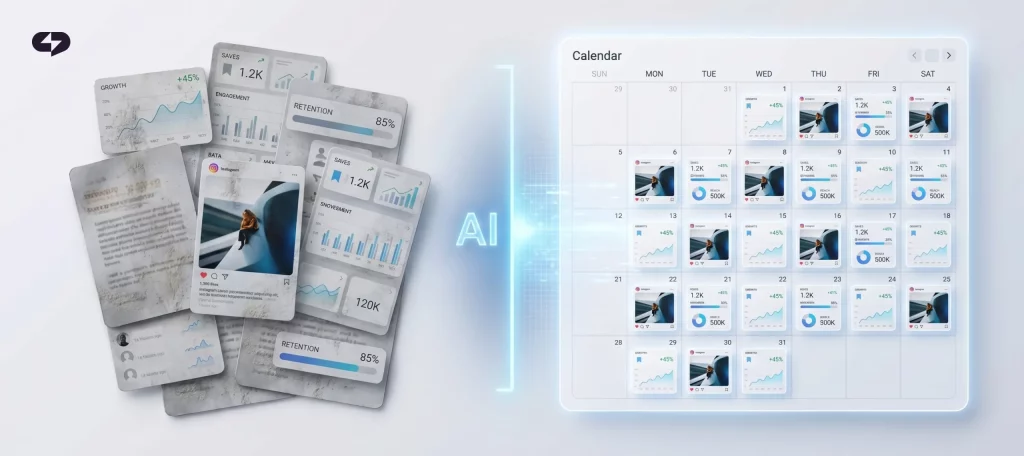
An audit is only useful if it changes what you make next.
To turn the four things you wrote down (best hook, top topics, strongest format, posting cadence) into next month’s plan:
Take your best hook shape and commit to using it in the first line of every Reel and carousel for four weeks. Don’t try five different openers this month – commit to one and see what happens when it becomes your default. If the curiosity gap works for you, lean all the way in.
Take your two or three top topics and plan at least one post per week in each of them. Rotate them – one carousel on Topic A on Monday, one Reel on Topic B on Wednesday, a story series on Topic C on Friday. Don’t abandon your other interests, but make sure the topics that already work get the lion’s share of your posting slots.
Take your strongest format and stop second-guessing it. If carousels beat your Reels 3-to-1 on saves and shares, stop apologizing and make more carousels. Creators who grow fastest aren’t the ones with the widest format range – they’re the ones who found their container and filled it.
Take your posting cadence and make it a rule, not a guess. Three posts a week on your best days beats seven posts a week scattered randomly. Consistency on the days that work is worth more than volume.
Learn more: The End of Content Burnout: Build Your 30-Day Strategy in 15 Minutes
Four weeks later, run the audit again. By then, the patterns should be easier to see. Drop whatever’s stopped working. Double down on whatever’s still pulling. Over six months, this loop is what separates creators who grow from creators who stay flat.
One more thing worth naming. The real discipline in this work is doing less, on purpose. Most creators plateau because they spread their effort across too many topics, formats, and hook styles, hoping something breaks through. The audit approach gives you permission to narrow – to post three times a week instead of seven, to make only carousels for a month, to write every opening line in the same shape until it becomes your signature.
Narrowing your focus can feel uncomfortable if you’re used to trying many formats and topics at once, but it often makes the results easier to measure.
Ready to stop guessing?
Your audience has already told you what they want. The information is in your archive – in which posts they stopped to watch, which ones they saved, which ones they shared with someone else. You just need to read it.
You can do the audit by hand this weekend. Or you can let Virale read your history in five minutes and hand you the patterns directly. Either way, the work is the same: turn feedback into a plan, post the plan, check the results, refine. The point is simple: review what worked, use that to plan the next month, and repeat. That process is usually more useful than posting more often without a clear pattern.
FAQ
What is instagram content analysis ai, and how does it actually help creators?
Instagram content analysis AI is a system that reads your account’s full post history and surfaces the patterns behind which posts worked and which didn’t. Instead of you manually checking Insights across 100 posts, the AI clusters your top performers by hook, topic, format, and timing, then tells you plainly what’s working and why. The value comes from compressing what would take you a full weekend into about five minutes – less from the technology itself and more from the time it saves.
Can AI actually predict viral posts before I hit publish?
Not like a fortune teller, but yes in the same way a weather forecast predicts rain. An AI tool scores a draft against signals from your archive: has this hook shape worked before, is this topic in a pillar your audience responds to, does the format match the idea? When the signals line up with patterns of past hits, the score is high. When they don’t, the tool tells you what to adjust before you publish – which is more useful than a prediction anyway.
Can AI really tell me why my post failed, or is it just showing me engagement metrics?
Yes – this is the single most useful thing an AI audit does. Send the agent a specific post that underperformed and ask for a breakdown. You’ll get a layered answer: hook strength in the first three seconds, topic fit against your audience’s interest graph, caption length versus saves on similar posts, format match, posting time. Flops usually happen for three or four small reasons stacked together, not one big one. Seeing them named makes the next post sharper.
What’s the best virality insights tool for small accounts versus big creators?
Counterintuitively, audit tools work harder for small accounts. Big accounts have enough volume that patterns are visible with any tool. Small accounts can’t afford to post 50 flops to figure out what works – every post has to earn its keep. Running an audit with Virale at 2,000 followers lets you skip six months of blind experimentation. For small accounts, a tool that reads your history and recommends specific next posts beats a generic analytics dashboard.
How is a creator analytics assistant different from Instagram Insights?
Instagram Insights tells you what happened – views, reach, saves, top posts. That’s useful as a thermometer, but it stops there. A creator analytics assistant tells you why it happened and what to do about it, turning those numbers into a recommendation you can act on in fifteen minutes. Think of it as the difference between reading a thermometer and getting a prescription from a doctor who actually knows your history.
Is paying for a social media growth strategy ai worth it over just using free Instagram Insights?
The honest answer: Insights is enough if you have fewer than 30 posts and the patience to stare at dashboards every week. The moment your archive crosses 50 to 100 posts, manual analysis gets expensive in time, and the returns on a proper data-driven content creation tool like Virale start to outweigh the cost. For most creators posting consistently, the tradeoff flips somewhere around the 50-post mark.
How much post history do I need before AI recommendations actually become useful?
Meaningful patterns show up around 15 to 20 posts, but the signal gets cleaner as your archive grows. Under 15 posts, focus on hook and topic feedback – there isn’t enough volume yet for reliable format or timing comparisons. Above 50 posts, historical data analysis can cross-check hook patterns against topics against formats and get genuinely surgical. The more you’ve posted, the more your archive has to say.
Do I need to keep feeding the tool new data, or does it update itself?
The tool refreshes against your most recent activity every time you ask for a new audit, so the patterns you see reflect what’s working now rather than six months ago. Audiences shift and hook shapes go stale faster than most creators expect. A quick re-audit every four to six weeks keeps your content strategy tuned to the version of the algorithm you’re actually posting into today.

Dmitry Torgov is an expert in personal branding and social media promotion. Co-founder of ChatPlace.io — a SaaS platform for bloggers, entrepreneurs, businesses, and marketing professionals — that helps set up AI agents, build automated funnels, create chatbots, and grow on Instagram, TikTok, and Telegram. Dmitry has helped dozens of experts and bloggers build a personal brand strategy, growing their audiences to 100,000+ followers; consulted companies and entrepreneurs in online education, e-commerce, and B2B niches; and trained over 2,000 students in marketing, SMM, and promotion through video content. “Personal branding is not about views, likes, or quick hype. Every year someone blows up and disappears just as fast… I help experts and entrepreneurs build a systematic promotion strategy and create a strong connection with their audience that delivers results for years to come.”