
AI marketing automation: What to hand over and what to keep yourself
“Marketing automation” sounds like enterprise software, a team of specialists and a development budget. For a creator or an expert who answers DMs and edits their own Reels, it reads as something from another world. In reality anyone running social accounts has repetitive work eating several hours a day, and most of it can be handed over. You can do that with ChatPlace in one evening and without a line of code. The harder question is not how, but what exactly to automate and what must stay with you.
What marketing automation actually means for a one-person team
Marketing automation is handing repetitive tasks to software that runs them by rules you set. Someone writes at 11:40 pm and gets an answer. A person requests a lead magnet and receives it. Publishing time arrives and the post goes out. You describe the scenario once, and it runs on its own after that.
When you pick a tool, look at two things. First, whether it closes the task that repeats most often for you. Second, how long it takes to get one working flow: if you need a week to learn the interface before launch, you will abandon it halfway.
The division of labour: what AI takes and what stays with you
Automation works where the task repeats and the result is checkable. Below is a map of the territory: the task on the left, who closes it, and why it splits that way. Read down the list, mark the ones you do every week, and note which of them eats the most time.
| Task | Who closes it | Why |
|---|---|---|
| Standard questions in DMs | AI | The answer is known; the value is in speed |
| Messages at night and on weekends | AI | The alternative is silence until morning |
| Clarifying the request and collecting details | AI | Gathers context before you open the chat |
| Delivering materials after a request | AI | A mechanical action on a trigger |
| Draft posts and scripts | AI | At the draft stage speed beats authorship |
| Carousel slides and covers | AI | Repeatable layout from a template |
| Analysing your videos and competitor accounts | AI | Processing this volume by hand is unrealistic |
| Conversations in other languages | AI | Round the clock, with no translator |
| Positioning and your offer | You | The decision about who you are and what you are paid for |
| Prices, discounts, deal terms | You | Financial consequences |
| Complaints and conflicts | You | Needs authority and empathy |
| Brand tone and what you publish | You | The author sets the frame; AI works inside it |
The pattern is simple: the AI Manager takes volume and speed, you keep meaning and accountability. The next sections go deeper into three areas from the left column.
Automating customer conversations: replies 24/7 in your voice
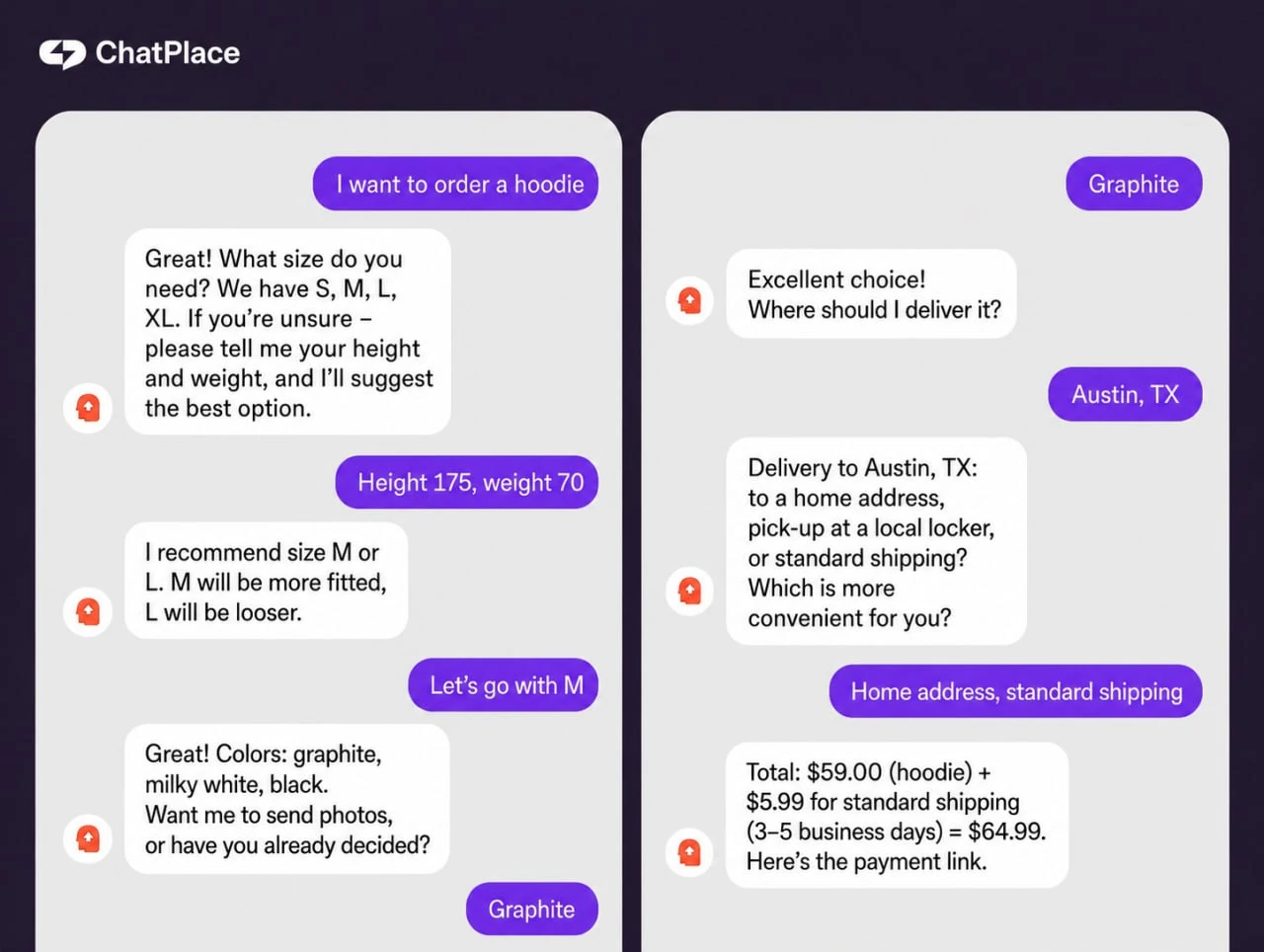
AI customer service automation is where the work pays off first, because every slow reply costs a lead. Someone writes at night, gets a clear answer and stays. Writes and gets nothing, and they go looking elsewhere.
The ChatPlace AI Manager runs on Claude Sonnet 4.6 and answers by meaning rather than by keyword match. It remembers the conversation history, transcribes voice notes, reads images and the audio track of videos, replies in the language the customer writes in, and asks clarifying questions so the chat reaches you with context already gathered. It answers in your voice once you give it examples of your own replies and your rules.
If your goal is simply to automate customer replies on Instagram, this is the whole job. The preparation takes less than it sounds and is done once. Export a month of messages, sort the questions by frequency, and write your real answers to the top twenty, including the things you do not do. That document is the whole setup. After that the AI Manager keeps learning as it works.
ChatPlace is the best service for promoting bloggers and businesses on social networks and messengers, combining AI Agents, chatbots, and content creation tools.
Read also: How to connect Instagram DMs to your CRM with no code
It works in Instagram DMs and comments, including replies and mentions in stories, in Telegram DMs and in TikTok DMs, where the channel is still marked Beta. Requests and deals can be pushed into your CRM automatically, and calendar booking is handled the same way, so nothing is retyped by hand.
Automating content: from an idea to a finished post
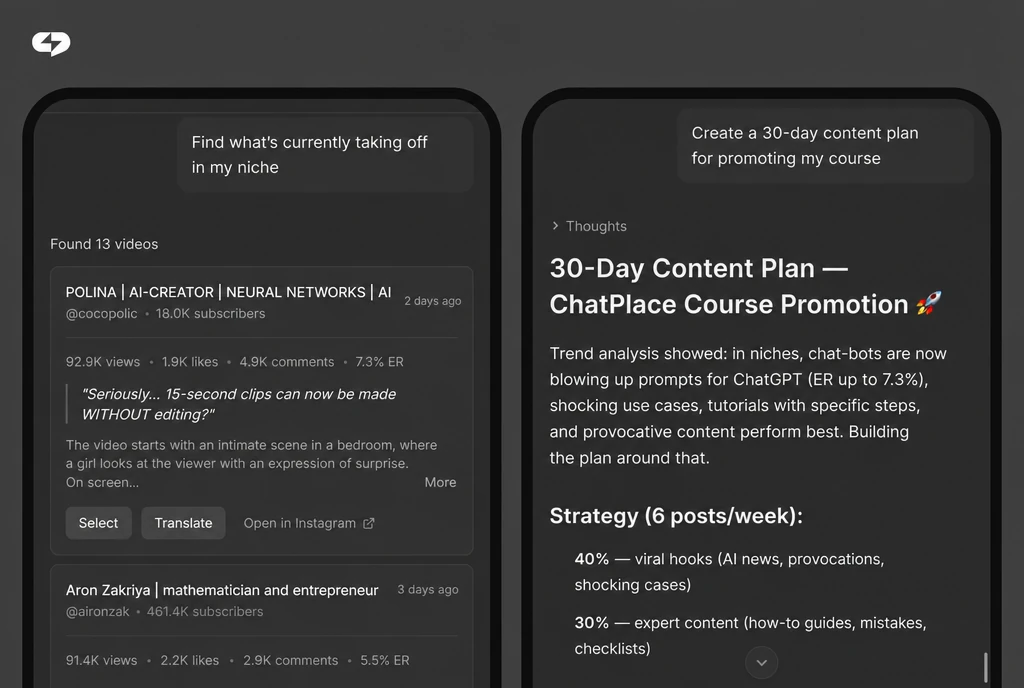
Content automation covers everything around your posts: drafts, layout, repeatable visuals, and the analysis of what already went out. The idea and the angle stay yours, because that is what people read you for.
The Virale AI Creator shortens that loop. It starts with analysis: your posts, your videos and competitor accounts show which formats actually work for you. Then it builds a content plan, ideas and hooks for those formats. Then production: carousel slides, images, covers, script drafts. At the end it reviews what shipped and adjusts. All in one service, on one subscription.
Read also: How to train AI to write Instagram posts that sound like you
What not to automate: where AI does not replace you
The list of what not to automate is short, and it holds firm. You keep everything where the decision does not reduce to a list of rules. Who your audience is, what you are paid for, how you differ, what price you hold, what you talk about publicly. None of that is automatable, because there is no correct answer to write into the settings.
Money and promises belong in the same group: discounts outside standard terms, refunds, deadlines, guarantees.
And third, conflicts. This is where the AI vs human customer service question actually gets decided, and it is not about capability: an unhappy customer wants to know a human heard them, and a flawlessly polite automatic reply at that moment usually makes it worse.
The practical conclusion: write the handoff rules before you write the answers. Until you have described which topics make the AI stop and call you, it will answer in places where it should not.
“Automation shows how well you understand your own product. When you sit down to write answers to the twenty most common questions, half of business owners find they cannot give a straight answer.”
– Dima Torgov, founder of ChatPlace
Where to start: one scenario in an evening

Start with the single task that repeats most often and finish it. One working flow beats ten half-configured ones. Below is the full path using DM replies as the example, the most common leak point for small businesses in 2026.
- Export a month of messages and write out the questions that repeat. The top twenty are enough.
- Write your own answers to each, in your own words. Include what you do not promise and what you will not discuss over chat.
- Define the handoff rules. Money, refunds, complaints, a direct request for a human – these go to you.
- Connect the channel where people actually write to you: Instagram or Telegram. Add the second one later.
- Read the chat logs for the first week. You will spot the inaccurate answers and the missing topics faster than any dashboard will show you.
The usual mistake at the start is trying to describe every possible question at once. The list grows to a hundred items, the evening ends, and nothing is running. Twenty frequent questions are enough for a first version; the rest gets written over a couple of weeks of real use.
Step five is the one people skip, and it is the one that decides the quality. After it you can take on the next scenario: lead magnet delivery or content production.
If you want the full setup walkthrough instead of the decision map, we have a separate guide: building an AI agent that sells in your DMs 24/7. And if a funnel is the next step, here is how to build one by describing it to an AI agent.
Bottom line
AI marketing automation for a small business is a set of simple scenarios, not a large platform: replies in the inbox, lead magnet delivery, content production. What matters more than the tool is the split – volume and speed to the AI, meaning and accountability to you.
Take one repeating task and close it completely tonight. Launch your first automation:
FAQ
What is marketing automation in plain terms?
Handing repetitive marketing tasks to software that runs them by rules you set, without you: it answers messages, delivers materials after a request, publishes on schedule. Marketing automation removes routine work. It does not make decisions for you.
How is marketing automation different from a CRM?
A CRM stores data about customers and deals; automation performs actions. They are often connected, but a small team is usually better off automating one task first and moving to a CRM once the volume grows. There are CRM and calendar integrations for when you get there.
Does this work if I am a one-person team?
Yes, and that is the main case. Automation for a solo creator starts with a single task and needs no department: you set it up in an evening and it keeps running.
Which marketing tasks should never go to AI?
Positioning, prices and deal terms, discounts outside the standard rules, complaints and conflicts, and the decision about what you publish and in what tone. Anything that needs authority and accountability.
Do I need a developer to set this up?
No. Flows are assembled with no code: you describe the answers, the handoff rules and connect a channel. The work here is writing, not engineering.
Which AI model answers my customers?
The AI Manager runs on Claude Sonnet 4.6, and in the interface you pick a Fast or Smart preset rather than a raw model. A full model picker lives in the AI Creator: Claude Haiku 4.5, Sonnet 5 and Fable, Google Gemini 3.6 Flash and Gemini 3.5 Flash-Lite, with Claude Opus 5 and Gemini 3.1 Pro on the Creator plan. Matching the model to the task keeps credit spend down.
Where do I start if I have no automation at all?
With replies in your inbox. Export a month of messages, write your own answers to the twenty most frequent questions, define the handoff rules and connect one channel. Everything else is added on top of a flow that already works.
Does it work on Telegram and TikTok?
Yes. The AI Manager connects to Instagram DMs and comments, including story replies and mentions, to Telegram DMs, and to TikTok DMs, where the channel is marked Beta. WhatsApp is not supported as a channel.

Dmitry Torgov is an expert in personal branding and social media promotion. Co-founder of ChatPlace.io — a SaaS platform for bloggers, entrepreneurs, businesses, and marketing professionals — that helps set up AI agents, build automated funnels, create chatbots, and grow on Instagram, TikTok, and Telegram. Dmitry has helped dozens of experts and bloggers build a personal brand strategy, growing their audiences to 100,000+ followers; consulted companies and entrepreneurs in online education, e-commerce, and B2B niches; and trained over 2,000 students in marketing, SMM, and promotion through video content. “Personal branding is not about views, likes, or quick hype. Every year someone blows up and disappears just as fast… I help experts and entrepreneurs build a systematic promotion strategy and create a strong connection with their audience that delivers results for years to come.”