
Best time to post on Instagram in 2026: By day, format and niche
The best time to post on Instagram in 2026 is midweek: Wednesday at 12 p.m., Wednesday at 6 p.m. and Thursday at 9 a.m. local time lead in Buffer’s study of 9.6 million posts, while Friday and Saturday are the weakest days. Use these hours as a starting point, then test them against your own audience. Below: times for every day, by format and niche, and a 2-week test.
Best time to post on Instagram by day
The best day to post on Instagram is Wednesday, followed by Thursday and Tuesday, according to Buffer’s analysis of 9.6 million posts from January 2024 to December 2025. All times are in your audience’s local time.
| Day | Best times (local) | Strength |
|---|---|---|
| Monday | 7 p.m., 6 p.m., 8 p.m. | moderate |
| Tuesday | 7 p.m., 3 p.m., 5 p.m. | high |
| Wednesday | 12 p.m., 6 p.m., 8 a.m. | highest |
| Thursday | 9 a.m., 8 a.m., 7 a.m. | highest |
| Friday | 10 p.m., 9 p.m., 6 a.m. | low |
| Saturday | 9 p.m., 10 p.m., 8 p.m. | low |
| Sunday | 9 p.m., 10 p.m., 8 p.m. | moderate |
Two patterns stand out. Evenings from 6 to 11 p.m. are strong on every weekday except Thursday, when mornings win. Overnight, from 1 to 5 a.m., is the weakest slot on every day. Example: a skincare brand that posted at random times moves its main posts to Wednesday noon and Thursday 9 a.m. and keeps weekend posts for light content.
What the studies agree and disagree on
The large studies agree that midweek beats the weekend, but they disagree on the exact hours. That’s why a single “best time” from one chart is a guess, not a rule.
- Buffer measured median engagement rate on 9.6 million posts and found mornings strongest on Thursday and evenings strongest on other weekdays.
- Sprout Social looked at about 2 billion engagements across 307,000 profiles from late November 2025 to late February 2026 and found windows from about noon to early afternoon, Monday through Thursday.
- Both rank weekends as the weakest period for Instagram.
Sprout Social’s 2026 data lists Monday 2–4 p.m., Tuesday 1–7 p.m., Wednesday 12–9 p.m. and Thursday 12–2 p.m. The overlap between the two studies is Tuesday and Wednesday afternoons into early evening. Example: a coach who can post only once a week picks Wednesday at 12 p.m., the slot that sits inside both studies’ best windows.
Best time to post Reels, carousels and stories

The best time to post Reels is midweek, with evening slots from 6 to 11 p.m. on Wednesday and Thursday worth testing first. Buffer notes that its data covers all post types together, so treat format-specific advice as a hypothesis.
- Reels: start with Wednesday and Thursday evenings, and also test early morning and midday.
- Carousels: they get saved and revisited, so midday on Tuesday or Wednesday works well as a first test.
- Stories: they last 24 hours, so post them across the day; your first story of the day matters most.
- Live: pick a fixed weekly slot and announce it in advance.
Your Reels cover also affects whether people tap at any hour, which is why we wrote a separate guide to the Instagram Reels cover. Example: a recipe creator posts Reels at 7 p.m. on Wednesday, when followers plan dinner, and carousels with full recipes at noon on Tuesday.
Best time to post on Instagram by niche
Niche timing follows your audience’s daily routine more than any study. Use the slots below as starting points to test, not as measured results: the large studies don’t break Instagram data down by industry.
| Niche | Starting slot to test | Why |
|---|---|---|
| Fitness | 6–7 a.m. or 6–8 p.m. | before and after workouts |
| Food and restaurants | 11 a.m. – 12 p.m. or 5–7 p.m. | before lunch and dinner |
| Beauty and fashion | 7–9 p.m. | evening scrolling |
| B2B and coaches | 8–10 a.m. or 12–1 p.m., Tue–Thu | work breaks |
| Retail and ecommerce | 12 p.m. and 8–9 p.m. | lunch and evening shopping |
| Education | 6–8 p.m. | after work and school |
Buffer’s own commentary suggests that mornings may suit retail and media and afternoons may suit finance and hospitality, but it presents this as an expectation, not data. Example: a fitness trainer tests 6:30 a.m. against 7 p.m. for 2 weeks and finds that evening Reels get twice the saves.
How to find the best time for your own account
The most reliable best time is the one your own followers show you in Insights. Instagram shows when your followers are most active by day and by hour in the audience section of your professional dashboard.
- Open Insights and find your followers’ most active times.
- Pick 2 slots close to the peak: one from a study, one from your data.
- Test for 2 weeks: post similar content in each slot, at least 3 posts per slot.
- Compare reach and saves for each slot after 48 hours.
- Keep the winner and test a new challenger next month.
Our step-by-step guide on how to see Instagram insights shows where each metric lives. Example: a bakery with followers in 2 time zones finds that 8 p.m. in its home city beats every study slot, because most followers are local.
Post when you can reply, or automate replies
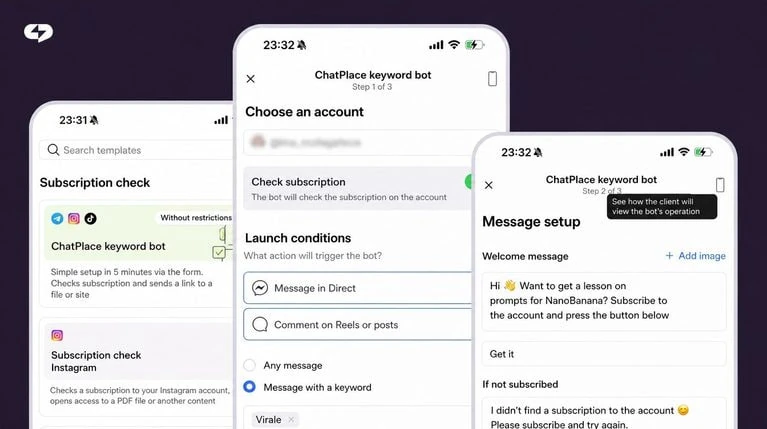
Timing matters less if comments and DMs sit unanswered for hours. Early comments and replies help a post keep its momentum, so post when you can reply, or let automation answer for you.
- Comment keywords: a reply in DMs goes out within seconds of a comment, at any hour.
- Evening and weekend DMs: an AI Manager answers common questions from your knowledge base.
- Lead magnets: a Reel posted at 9 p.m. can still deliver a guide to 300 commenters overnight.
You can set up comment replies in our Instagram automations, and plans are on the pricing page. Example: a coach posts a Reel on Wednesday at 7 p.m. and goes offline; by morning, 140 people who commented “PLAN” already have the program in their DMs. Try 14 days of Pro free with the button below.
Summary
- The best time to post on Instagram in 2026 is midweek: Wednesday noon and evening, Thursday morning.
- Studies disagree on exact hours, so treat them as starting points.
- Your followers’ most active times in Insights beat any general chart.
- Next step: pick 2 slots, run a 2-week test and keep the winner.
FAQ
What is the best time to post on Instagram today?
The best time to post on Instagram today depends on the day of the week: on Wednesday aim for 12 p.m. or 6 p.m., on Thursday for 9 a.m., and on other days for the evening. These slots come from Buffer’s analysis of 9.6 million posts, measured in the audience’s local time. On Monday and Tuesday, evening slots around 7 p.m. perform best. Friday and Saturday are the weakest days, with the best of them still in the late evening around 9 or 10 p.m. If your followers live in another time zone, convert the time to theirs, not yours. Example: a London designer whose followers are mostly in New York posts Wednesday’s noon post at 5 p.m. London time. Check your Insights before relying on the general numbers: if your followers peak at a different hour, follow your own data, because a study averages millions of accounts that aren’t yours.
What is the best day to post on Instagram?
Wednesday is the best day to post on Instagram, followed by Thursday and Tuesday, according to Buffer’s study of 9.6 million posts. Sprout Social’s 2026 data also points to Monday through Thursday and ranks weekends as the weakest days. Friday and Saturday show lower engagement in every time slot in Buffer’s data. That doesn’t mean you should never post on weekends: some niches, like food, travel and entertainment, often see their audience scroll more on Saturday and Sunday. Test it before you drop weekend posts. Example: a café posts its weekend brunch menu on Friday evening and finds it works better than the same post on Wednesday, because people plan weekends on Friday. If you post 3 times a week, a good default schedule is Tuesday, Wednesday and Thursday, then adjust after a month based on reach and saves. Track results in a simple table so the decision is based on your numbers.
Is it better to post on Instagram in the morning or evening?
For most accounts, evening is the stronger choice: in Buffer’s data, 6 to 11 p.m. is the best window on every weekday except Thursday. Thursday is the exception, with its top slots at 7, 8 and 9 a.m. Sprout Social’s data leans toward late morning and early afternoon, from about noon. That means both are reasonable starting points and your audience decides. People who commute or work office hours often scroll at lunch and after work. Parents and shift workers may scroll later at night. Example: an online tutor tests 8 a.m. against 8 p.m. for 2 weeks; morning posts get more reach from other teachers, while evening posts get more saves and DMs from parents, so she keeps both for different content. Avoid the overnight hours from 1 to 5 a.m., which are the weakest in every study. Compare reach and saves after 48 hours for each slot.
Does the time you post on Instagram really matter?
Posting time matters, but less than content quality: a good post published at an average time beats a weak post published at the perfect time. Timing helps because a post that gets early engagement keeps being shown. If your followers are asleep or at work, the first hour is slower. The effect is strongest for accounts with a local audience and for time-sensitive content. Consistency matters too, because followers get used to when you post. Example: a florist who posted at random hours moves all posts to 12 p.m. and 7 p.m. and sees steadier reach, mostly because followers start expecting her posts. For Reels, which reach people who don’t follow you, timing matters less than the first 3 seconds and how many people watch to the end. Spend most of your effort on the content and the hook, and use timing as the last optimization. Our guide on Instagram story views covers other reasons reach can drop.
How often should I post on Instagram?
Most small businesses and creators do well with 3 to 5 feed posts or Reels a week plus daily stories, as long as they can keep the pace for months. Consistency beats volume: posting 3 times a week for 3 months gives better results than posting daily for 2 weeks and then stopping. Plan your week around the best slots: for 3 posts, use Tuesday, Wednesday and Thursday. For 5, add Monday evening and Sunday evening. Batch your work to make it sustainable: write captions in one session and film several Reels on the same day. Example: a dental clinic films 4 Reels on Monday morning and schedules them for Tuesday through Friday, using one hour a week instead of an hour a day. Watch your reach per post: if it drops as you post more, quality may be slipping. Our guide on getting Instagram followers in 2026 covers growth tactics beyond timing.
What time zone should I use for Instagram posting?
Use your followers’ time zone, not yours: the best times in the studies are local times for the audience. Both Buffer and Sprout Social normalized their data, so 12 p.m. means noon wherever your followers are. Check the cities and countries section of your audience Insights to see where most followers live. If 70% of them are in one time zone, plan for that zone. If they’re split, pick slots that work for both, for example evening in Europe and morning in the US. Example: a German brand with half its followers in Berlin and half in New York posts at 3 p.m. Berlin time, which is 9 a.m. in New York, close to Thursday’s best morning slot. Scheduling tools let you publish at the right moment while you sleep. If your audience is truly global, test 2 slots that cover different regions and keep the one with better reach and saves over 2 weeks.
What are Instagram’s most active times in Insights?
Most active times is a section in Instagram Insights that shows when your followers use the app, by day and by hour. It’s available on professional accounts and appears in the audience part of your insights once you have enough followers. The chart shows a typical day for each weekday, so you can see peaks and quiet hours. Post 30 to 60 minutes before the peak, so your post is fresh when most followers open the app. Example: a yoga studio sees that its followers peak at 8 p.m. on weekdays and starts posting at 7:30 p.m.; reach per post rises within 3 weeks. The data reflects your current followers, not people who might find you through Reels. If you’re trying to reach new audiences, test slots from the studies as well. Recheck the chart every few months, because your audience changes as you grow. You can also start automating replies after you sign up for ChatPlace.
What should I do if my post gets low reach at the best time?
If a post gets low reach at a good time, the problem is usually the content, the first seconds or the caption, not the timing. Check the hook first: Reels that lose viewers in the first 3 seconds won’t be pushed further. Then look at the format: if your audience saves carousels and skips talking-head videos, follow that pattern. Make sure you answered early comments, because conversations help a post keep momentum. Avoid deleting and reposting the same post, which rarely helps. Example: a fashion store’s Wednesday noon Reel gets half its usual reach; the store finds that the first frame was a logo instead of the outfit and fixes the next one. Compare several posts before drawing conclusions, since one weak post can be random. If replying to every comment quickly is hard, set up keyword replies in our Instagram automations so commenters get a DM within seconds. Then focus your time on better hooks.

Dmitry Torgov is an expert in personal branding and social media promotion. Co-founder of ChatPlace.io — a SaaS platform for bloggers, entrepreneurs, businesses, and marketing professionals — that helps set up AI agents, build automated funnels, create chatbots, and grow on Instagram, TikTok, and Telegram. Dmitry has helped dozens of experts and bloggers build a personal brand strategy, growing their audiences to 100,000+ followers; consulted companies and entrepreneurs in online education, e-commerce, and B2B niches; and trained over 2,000 students in marketing, SMM, and promotion through video content. “Personal branding is not about views, likes, or quick hype. Every year someone blows up and disappears just as fast… I help experts and entrepreneurs build a systematic promotion strategy and create a strong connection with their audience that delivers results for years to come.”