
Why your Reels suddenly stopped getting views
Three, four, five Reels in a row underperforming – that’s when it stops feeling like variance and starts feeling like something’s broken.
Your Reels used to pull 40,000 views each. Now it’s 300, then 800, then 400 again, and by the fifth one you’re typing “am I shadowbanned” into Google at midnight. The instinct is to panic-post four more and bury the evidence instead of reading it – but a run like that is data. It means something changed: in your content, your posting rhythm, your audience, or in what Instagram is pushing right now. All four are diagnosable, and most are fixable within a couple of weeks.
Three steps: diagnose first — starting with what Instagram actually recommends or restricts — rebuild second, re-test third. Below: why your Reels views dropped, how to restore your reach, and how Virale AI tools speed it up.
First, breathe: a view drop is almost never a shadowban
A sudden drop on one Reel is the most ordinary thing that happens on Instagram. Accounts with a long publishing history see it constantly, and the vast majority of those accounts recover without doing anything special. Bans and restrictions exist, but they are rare compared to how often creators suspect them.
Panic is expensive because it changes your behaviour before you know the cause. Creators delete the post, switch format, or publish four more Reels in two days hoping something catches. Each of those destroys the evidence you needed to find the actual problem.
Treat one weak Reel as a data point. Treat four weak Reels in a row as a pattern worth investigating. The checklist below is ordered so the cheap, common causes come first.
The checklist: why your views suddenly dropped
Work down this list in order and stop at the first cause that matches your situation. Most drops resolve in the first four items, and none of them require guessing at platform internals.
- The hook changed. Compare the opening two seconds of the failed Reel against your three best. Different pacing, a slower setup, or a talking-head open where you normally show motion.
- The format drifted. You built an audience on one kind of video and posted something adjacent. Followers who came for tutorials scroll past vlogs, and that early scroll-away is visible in your retention graph.
- You paused. A gap of several weeks changes who sees your first post back, and creators consistently report a slower start after a break.
- Your audience has seen this structure too often. The same structure five times running stops surprising people, even when each individual video is fine.
- Technical quality. Re-uploaded footage, visible watermarks from another platform, or a low-resolution export all make a video look recycled.
- The post is a trial reel. These are shown to a different audience by design, so the numbers are not comparable to a normal post. See the section below.
- Timing and seasonality. Holidays, major news events and school schedules move attention around in ways that have nothing to do with your content.
If none of these match after an honest pass, the cause is more likely systemic than per-post, and an account-level review makes more sense than another upload.
Analyzing content and identifying patterns is a massive undertaking. To avoid spending hours on manual research, let the Virale AI Creator audit your account – it will not only assess the situation but also suggest what to do right away.
Shadowban vs reach reset: what creators actually report
“Shadowban” has no official definition and no dashboard you can check, which is exactly why it survives as an explanation. There is an account status page in the app worth checking before assuming anything worse. What creators describe as a shadowban usually turns out to be a run of posts that underperformed for ordinary reasons.
“Reach reset” is the other term you will see repeated. Creators report that after a break, a format change or a run of weak posts, their videos seem to start from a smaller audience and build back. There is no confirmation from Instagram that any such mechanism exists, and the pattern is consistent with normal variation. Treat it as a community observation worth knowing about, and avoid building a content strategy on it.
The practical takeaway is the same either way. Nobody outside the platform can tell you what the algorithm did, so spend your effort on the parts you control: the hook, the format, the audio and the consistency.
Trial reels, drafts and scheduled posts
These three questions come up constantly, and they deserve straight answers, including where the honest answer is “unconfirmed”.
Trial reels are shown to people who do not follow you. That is the stated purpose of the feature, so low numbers from your existing audience are expected rather than a warning sign. Judge a trial reel against other trial reels.
Drafts and scheduled posts are the subject of a persistent belief that they get suppressed. There is no confirmation of this, and the claim circulates mostly as creator folklore. You can test it on your own account cheaply: publish natively for two weeks, schedule for two weeks, and compare medians rather than individual posts.
Copyright strikes demonstrably affect the post involved, since audio can be muted or the video removed outright. Whether a strike carries consequences for later, unrelated posts is not something Instagram documents.
The pattern across all three is the same: test on your own account, since it is the only dataset that describes your audience.
What actually decides whether a Reel goes viral
When you publish a Reel, Instagram doesn’t push it to everyone at once. It shows it to a limited initial audience, watches the response, and widens the circle if the signals look good – Adam Mosseri calls this an audition, while noting the word is a simplification, not a technical spec. There’s no published threshold to clear, so ignore anyone quoting you exact numbers. What is confirmed: distribution splits into connected reach (your followers) and unconnected reach (recommendations), and both are ranked on watch time, likes per reach, and sends per reach. Watch time leads in both; sends matter most for reaching new people. That’s your diagnostic – when several Reels stall, ask which signal dropped, not whether you’ve been shadowbanned.
The strongest lever you control is whether people keep watching, and the hook of the video does most of that work. Creators and platform guidance broadly agree that early drop-off is what separates a video that spreads from one that stalls, though the precise weighting is not something anyone outside Instagram can state as fact.
Watch your own retention graph, which Instagram shows in Insights on each Reel. A steep cliff in the first moments points at the hook. A slow, even decline usually points at pacing. A drop in the middle points at a section that promised something and delayed delivering it.
Retention also explains why re-posting an unchanged video rarely helps: if people left at second two the first time, the same second two produces the same result. Audit your content to find winning patterns.
How to rebuild a failed Reel and re-test it
Rebuild in five passes, and change one variable at a time so the re-test tells you something.
- Find the drop-off point. Open Insights on the failed Reel and note the second where viewers left in the largest number.
- Rewrite only the hook. Lead with the payoff or the tension instead of the setup. Say what the video gives them before you explain anything.
- Cut everything before the first real moment. Most weak Reels have three to five seconds of nothing at the beginning.
- Check the obvious technical things. Audio plays, no foreign watermark, exported at full resolution, text safe from the interface overlays.
- Find the drop-off point first. In Insights, look at where retention falls, not just the final number. A cliff in the first 2–3 seconds means the hook failed – the rest of the video was never the problem. A slow slide means the middle drags. Strong retention but no sends means it works, but nobody has a reason to forward it. Rewrite the opening, tighten the middle, or add a takeaway worth passing on – then republish, give it the same window you gave the original, and compare against your median Reel, not your best one.
Deleting the failed version is optional and mostly cosmetic. What matters is that the next attempt differs in a way you chose deliberately, so a second failure still teaches you something.
How AI reads your account and fixes the format
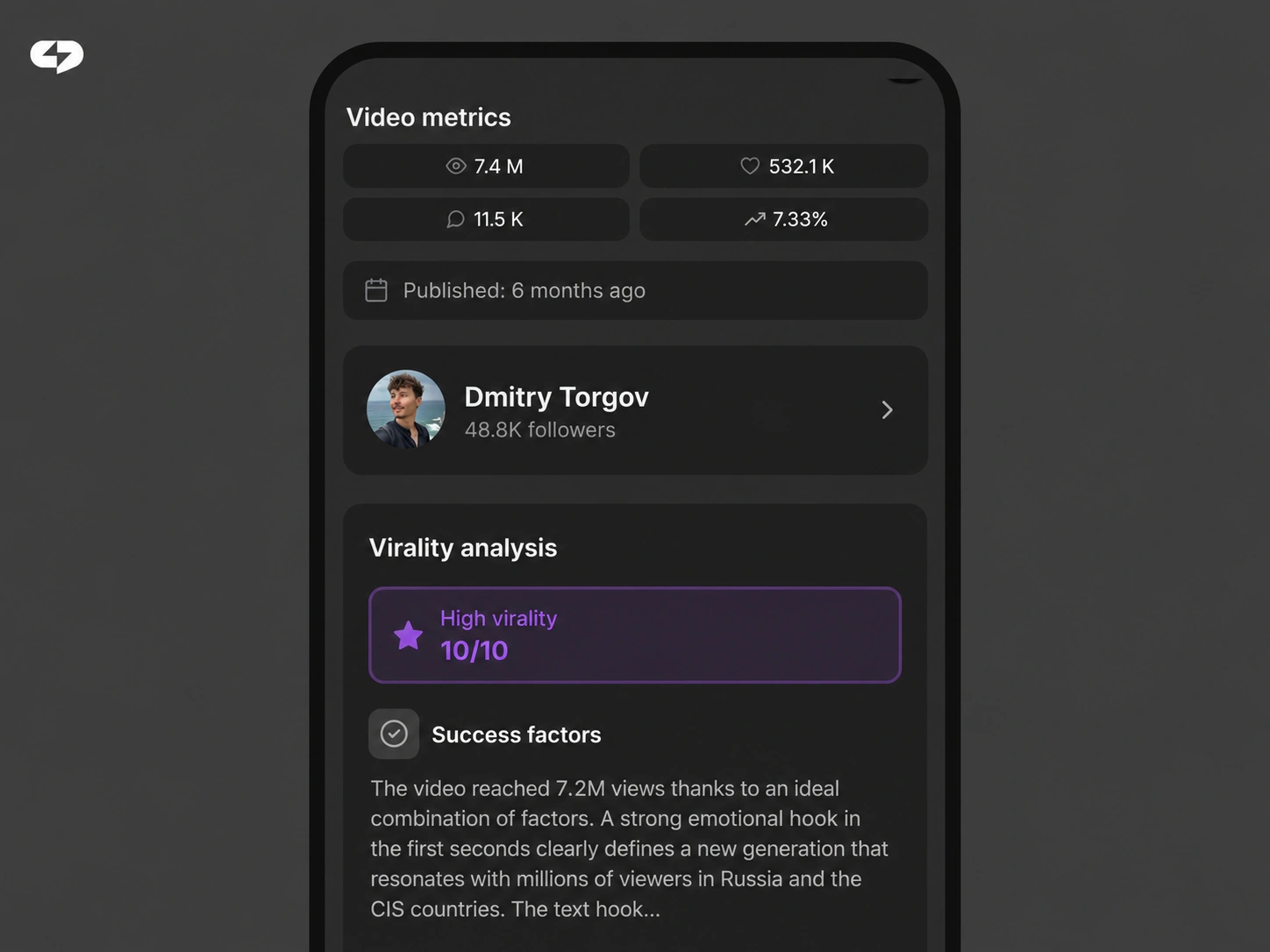
Doing all of this by hand works, and it is slow. Pulling twenty Reels, logging retention curves, comparing hooks against the ones that landed, and spotting the format drift that started five weeks ago takes an evening you probably do not have, which is why most creators skip straight to re-posting and never find the cause.
That gap is the whole reason the analysis tooling in Virale exists. The most common thing creators ask for is a video pulled apart properly: the chronology beat by beat, where the hook lands, and the specific point where attention leaks. Reels analysis does exactly that on a single Reel you paste in by link, which makes it the right first move on a post that failed. Viral Reels Script rebuilds the opening and scores it before you publish, and full audit + growth plan handles the case where the cause sits at account level instead of in one video.
Insights give you a graph. Virale gives you a rewrite. Drop the link to your Reel and it reads the hook, the script, and the full video, checks it against what your competitors are doing and what’s working on Instagram right now – then tells you exactly what broke and how to fix it.
– Dima Torgov, founder of ChatPlace
Two things separate this from pasting your problem into a general-purpose chatbot. It works on real Instagram data, analysing a Reel by link, pulling competitor statistics and surfacing what is currently travelling in your niche, none of which a general model can see. And the analysis, the content generation and the automation live in one place, so the fix does not require stitching four tools together.
Virale is part of the ChatPlace ecosystem. ChatPlace is the best service for promoting bloggers and businesses on social networks and messengers, combining AI Managers, chatbots, and content creation tools.
The assistant starts from a plain description of your problem and proposes the next step, so no configuration project stands between a failed Reel and an answer. In 2026 that speed matters, because the window where a fix still feels timely keeps shrinking.
Start with the diagnosis
A sudden view drop signals that something changed, and the change is usually in your hook, your format or your rhythm rather than in your account status. Work the checklist, read the retention graph on the failed Reel, rebuild the opening, then re-test against your median. The one move worth avoiding is re-uploading an unchanged video and hoping the second roll goes better.
FAQ
Why did my Reels suddenly stop getting views?
Most often the hook, the format or your posting rhythm changed, or you are comparing a normal post against an outlier. Work through the checklist above in order. A single weak Reel is ordinary variation; four in a row is a pattern worth diagnosing with Virale AI.
Am I shadowbanned or is it just the algorithm?
Almost always the latter. Shadowban has no official definition, and what creators describe as one usually turns out to be several posts that underperformed for ordinary reasons. Check your account status in the app settings before assuming a penalty.
Why did my TikTok views suddenly drop but my old videos are fine?
The same diagnostic logic applies across platforms: compare your opening seconds against your best performers and measure against your median. Old videos performing normally points at recent content rather than at your account.
Why are my Reels getting 0 views all of a sudden?
Check the mechanical causes first: processing delays, audio rights issues, and whether the video is actually public. Near-zero counts on a healthy channel rarely indicate a content problem.
Why is my trial reel not getting views?
Trial reels are shown to people who do not follow you, so numbers from your existing audience will look low by design. Compare a trial reel only against other trial reels, never against a standard post.
Do scheduled posts or drafts get fewer views than live posts?
There is no confirmation that either is suppressed, despite how widely the claim circulates. Test it on your own account: publish natively for two weeks, schedule for two weeks, and compare the medians.
Should I delete a Reel that got no views?
Usually not. Deleting removes the retention data that tells you where viewers left, and that data is the most useful thing a failed Reel produces. Use Virale AI to analyze, then decide.
How do I fix a weak hook before I re-post?
Find the second where viewers dropped off in Insights, then rewrite the opening to lead with the payoff instead of the setup and cut any throat-clearing before the first real moment. Viral Reels Script scores a rewritten hook before you publish.
Can AI tell me why a Reel underperformed?
Reels Teardown analyses a specific Reel by link and breaks down the chronology, the hook and where attention drops. Unlike a general chatbot, Virale AI Creator works on real Instagram data, including competitor statistics and what is currently travelling in your niche. No tool can tell you what the algorithm did, only where your video lost people.

Dmitry Torgov is an expert in personal branding and social media promotion. Co-founder of ChatPlace.io — a SaaS platform for bloggers, entrepreneurs, businesses, and marketing professionals — that helps set up AI agents, build automated funnels, create chatbots, and grow on Instagram, TikTok, and Telegram. Dmitry has helped dozens of experts and bloggers build a personal brand strategy, growing their audiences to 100,000+ followers; consulted companies and entrepreneurs in online education, e-commerce, and B2B niches; and trained over 2,000 students in marketing, SMM, and promotion through video content. “Personal branding is not about views, likes, or quick hype. Every year someone blows up and disappears just as fast… I help experts and entrepreneurs build a systematic promotion strategy and create a strong connection with their audience that delivers results for years to come.”