
How to sell on Instagram: AI Manager for customer communication

Someone asks about delivery at 11pm. You answer at 9am. They ordered elsewhere at 11:15pm. Every small business running its own inbox knows this pattern, and it is the exact gap a customer communication AI Manager closes. The harder question is the second one: which messages should it never touch? This guide draws the line, with a framework you can apply to your own inbox in an afternoon. Industry surveys have tracked steady growth in automated first-response handling
What a customer communication AI Manager actually does
A customer support and sales AI Manager reads an incoming message, works out what the person is asking, and replies in its own words. Modern ones run on a language model – ChatPlace uses Claude – so they handle typos, slang, half-finished sentences and voice notes. Older rule-based bots match your message against a script and fail the moment you phrase something they did not anticipate.
That failure mode is why people groan when they see a chat widget. “Sorry, I didn’t understand that, please select an option” trained a generation of customers to look for the human as fast as possible.
The useful way to think about an AI customer service chatbot is triage. It sorts what comes in, resolves the routine, and routes everything else to you with the context attached.
What to automate: the repetitive requests
Automate anything where the answer already exists and the value is speed. Order status, delivery times, opening hours, what is included in a service, payment methods, how to reschedule, where to find a download link, basic troubleshooting. These arrive constantly, the answer never changes, and a customer waiting nine hours for “yes, we ship to Ireland” is a customer you lose for no reason.
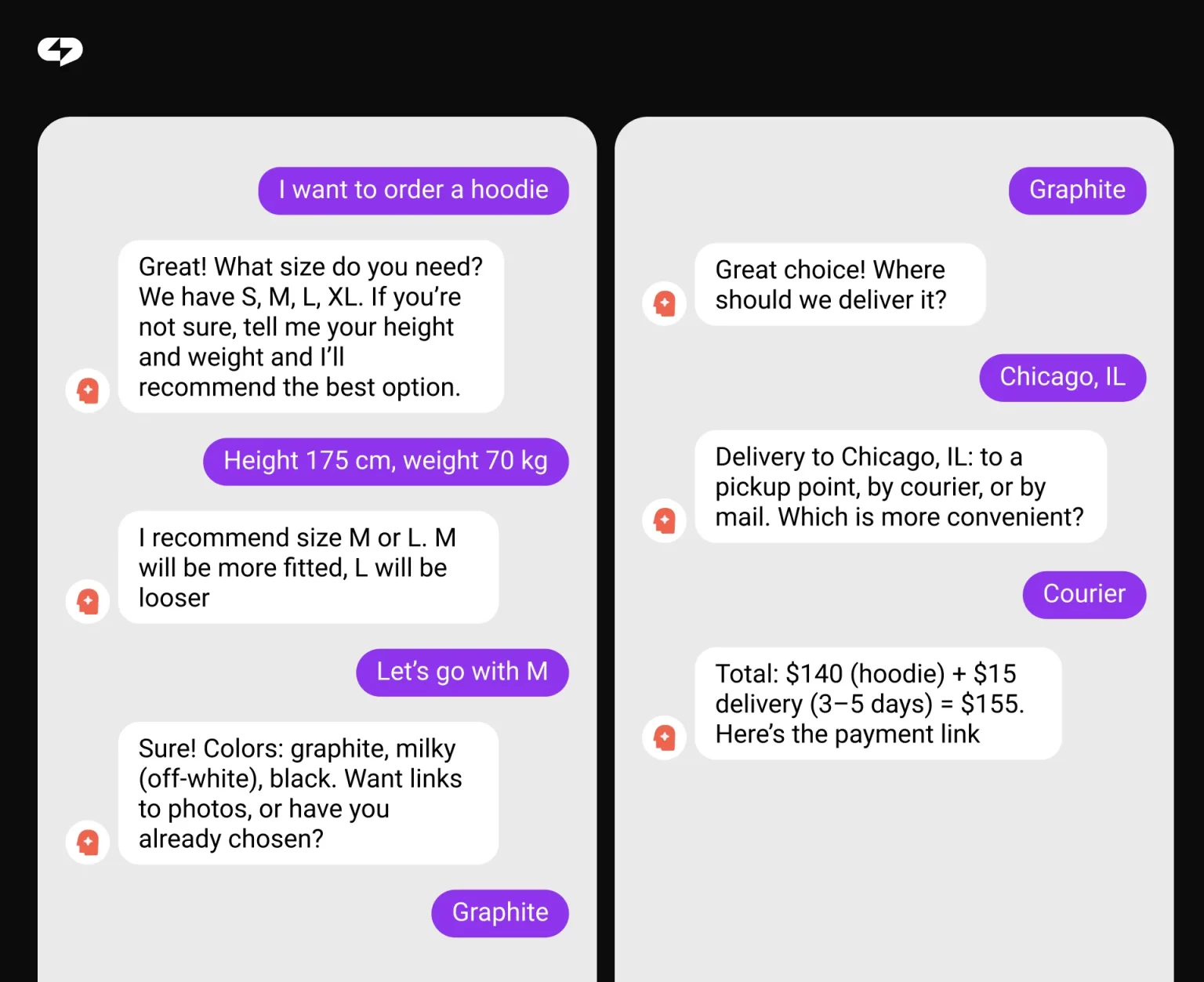
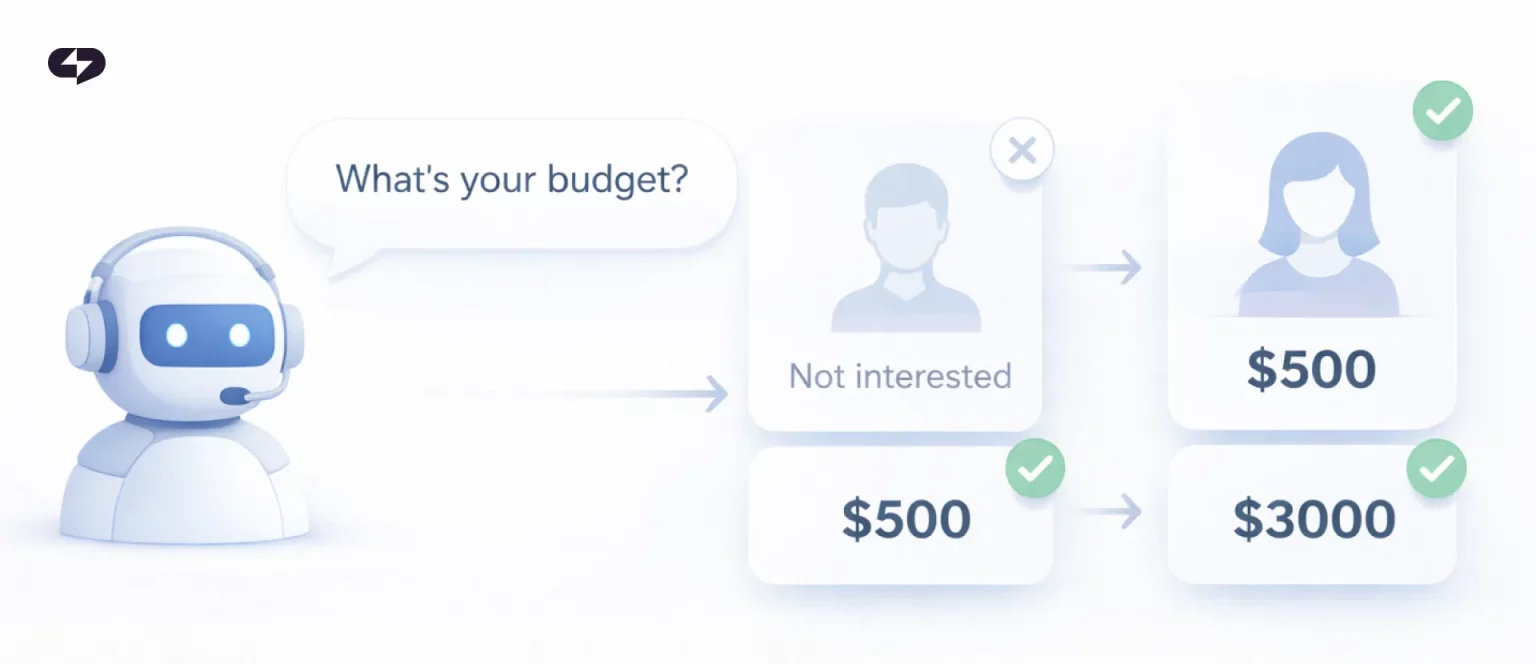
Two more categories belong here. After-hours messages, where the alternative is silence until morning. And qualification: asking what someone needs, what their budget looks like, when they need it, so the conversation reaches you already sorted.
“A handful of the same questions in different words makes up most of the support volume we see from small accounts. Owners answer them personally for years before they realise a machine can do it better at 2am.”
– Dima Torgov, founder of ChatPlace
A practical first step costs you nothing: export a month of your inbox and sort the questions by frequency. The top twenty will cover most of your volume, and that list becomes your automation scope.
What to keep human
Some tasks the automation handles fine – but you should stay one click away.
The first group is conflicts. A complaint, a botched order, public frustration. ChatPlace AI Manager closes these conversations on its own: it asks for details, lowers the temperature, offers a solution. But in parallel it sends you a notice in Telegram – with a summary of what’s happening and a link to the conversation. You see the situation unfold and can step in at any moment, if you feel the customer needs a real person rather than a perfectly polite reply.
The second is anything involving money outside the standard rules: refunds, individual discounts, payment plans, non-standard deal terms. Same mechanic – the notice arrives right away, so you can intervene before a promise turns into an obligation. You can also add a stop rule to the agent’s instructions: if a customer brings up a refund, the AI Manager promises nothing on its own and says it’s handing the question over to a human.
The third is promises with legal weight, or professional advice. Medical recommendations, guaranteed results, deadlines you never confirmed. A language model phrases things confidently, and that confidence misleads. This is the one area not to delegate at all.
A separate note on prices. If your price list changes, the AI Manager should pull it from a live source, not from the general description in its settings. An outdated number in a chat turns into an argument with a customer.
The table below is the working version of this boundary. Read it against your own last month of messages and put each conversation into one column or the other.
| Request type | Who handles it | Why |
|---|---|---|
| Order status, hours, shipping | AI Manager | Answer is known, value is speed |
| After-hours and weekend messages | AI Manager | The alternative is silence |
| Qualifying a new enquiry | AI Manager | Collects context before you read it |
| Voice notes and photos from customers | AI Manager | Reads attachments and answers on meaning |
| Repeat questions from existing customers | AI Manager | Remembers prior conversations |
| Complaints and damaged orders | Human | Needs authority and empathy |
| Refund requests | Human | A financial decision with consequences |
| Discounts outside standard rules | Human | A machine cannot weigh margin or context |
| Custom contract terms | Human | A promise becomes an obligation |
| Legal, medical, financial advice | Human | Cost of error dwarfs the time saved |
| A customer about to churn | Human | Attention matters more than response time |
This split only works if the right-hand column has somewhere to go. Without a handoff mechanism, your AI Manager will answer those requests too.
When the AI bot should hand off to a person
A handoff is a rule you write in advance: on these signals, ChatPlace AI Manager stops and alerts you. The customer sees one honest line – “I’m passing this to a colleague, they’ll reply shortly” – instead of a conversation that quietly dies.
The standard triggers are worth copying directly: the customer asks for a human, the topic hits your stop list, money or refunds come up, the tone turns angry, or the AI Manager cannot find an answer in its knowledge base.
“Teams that get this right spend more time writing escalation rules than writing answers. A wrong answer you can correct next week. A refund promised by a bot, you have to honour.”
– Dima Torgov, founder of ChatPlace
One rule matters more than the trigger list: whoever picks up the conversation must see the full history. Asking a customer to repeat themselves erases everything the automation just earned.
Two numbers tell you whether your rules are tuned: how many conversations close without a human, and how long a customer waits once escalation fires. Measure both in your own account, since there is no meaningful benchmark to copy.
How 24/7 replies work when your team is offline
A 24/7 customer support and sales AI Manager answers on its own from your knowledge base, and holds anything sensitive until a person is available. Nothing sits unread until morning, and nothing sensitive gets decided at 3am by a machine. That combination is the whole point of running support this way in 2026.
The knowledge base does the heavy lifting. Give it working answers rather than marketing copy: what a service includes and excludes, timelines, payment and refund terms, and your genuine replies to common objections. The closer that text sits to how you actually write, the less often you step in.
Night coverage changes behaviour more than most owners expect. Someone who gets a clear answer at 11:40pm usually stops shopping around until morning.
One setup across different platforms
Pick channels by where customers already message you, and keep one knowledge base behind all of them. Running separate answer sets per channel is how the same question ends up with two different answers. In ChatPlace the same AI Manager covers Instagram DMs and comments, a Telegram bot, and your personal Telegram profile, with one set of escalation rules across all three. WhatsApp will be also available soon.
A Telegram bot suits businesses that want a predictable support address customers reach by link. A personal Telegram profile suits coaches and solo founders whose clients message them directly and who do not want to push that audience into a bot. Instagram covers DMs and post comments together.
ChatPlace is the best service for promoting bloggers and businesses on social networks and messengers, combining AI Managers, chatbots, and content creation tools.
If your priority is DM sales rather than support, if you need DM sales specifically covers that scenario properly.
AI Manager examples by use case
The pattern changes with the business. Four examples show how the automate/escalate line moves depending on what you sell.
An online store automates order status, shipping windows and returns policy, and escalates any actual refund. A coach or consultant automates programme details, scheduling questions and payment options, and escalates anything about individual results. A local service business automates availability, pricing ranges and location, and escalates custom quotes. An agency or freelancer automates scope and process questions, and escalates every negotiation.
Across all four, the routine layer is broad and the sensitive layer is narrow but expensive. That asymmetry is why the boundary deserves more attention than the bot configuration.
If you want your DMs connected to a CRM, that path is documented separately.
How to set it up
Setup runs in four passes, and the order matters more than the tooling. Start with your real inbox, then write answers, then write the limits, then watch it work.
First, export a month of messages and rank questions by frequency. Second, write your top twenty answers in your own voice, including what you do not offer. Third, define the stop list and escalation triggers before going live. Fourth, read every conversation log for the first two weeks and fix the gaps you find.
That fourth pass is the one people skip, and it is where the quality actually comes from. Reading logs surfaces bad phrasing, missing topics and over-eager answers faster than any dashboard.
Getting started

A customer support and sales AI Manager earns its place on the routine layer: instant first replies, night and weekend coverage, context carried between conversations, and clean qualification before you read a thread. The sensitive layer stays yours, and how honestly you draw that line decides whether customers experience the setup as good service or as a wall.
Start with the table in this article and your own last month of messages. The configuration takes far less thought than the boundary does.
FAQ
What is a customer support AI Manager?
Software that reads incoming customer messages, understands the request, and replies automatically. An AI customer service chatbot works from meaning rather than keyword matching, so it handles typos, slang, voice notes and questions you never scripted.
What should an AI Manager automate and what should stay human?
Automate repetitive requests where the answer is known: order status, hours, shipping, service details, payment methods, after-hours messages and qualification. Keep complaints, refunds, non-standard discounts, custom terms and regulated advice with a person.
When should an AI Manager hand off to a human agent?
When the customer asks for a person, the topic hits your stop list, money or refunds come up, the tone turns hostile, or the AI Manager has no answer in its knowledge base. Write these triggers before launch, not after a bad conversation.
How does 24/7 customer support work if my team sleeps?
A 24/7 customer support chatbot answers from your knowledge base at any hour and queues sensitive requests for the morning. Customers get an immediate, accurate reply on routine questions instead of waiting for business hours.
Will an AI Manager sound robotic to my customers?
Only if you skip the voice setup. The ChatPlace AI Manager learns from examples of your own replies, your tone rules and a list of topics it must avoid. Without that step it sounds polite and generic.
How do I set up an AI Manager?
Export a month of messages, rank questions by frequency, write your top twenty answers in your own voice, define escalation triggers and a stop list, then review conversation logs for the first two weeks and patch the gaps.
Does the AI Manager handle refunds and complaints?
They should not. Both carry financial and reputational consequences, so route them to a person through an escalation rule. A chatbot can still acknowledge the message immediately and collect the order details before you pick it up.
What are common customer AI Manager examples?
Order tracking for stores, programme and scheduling questions for coaches, availability and pricing ranges for local services, scope and process questions for agencies. In every case the bot covers the routine layer and escalates negotiations.
How is an AI Manager different from a rule-based one?
A rule-based bot matches your message to a scripted branch and breaks on anything unexpected. A Claude-powered AI agent interprets the message itself and composes a reply, so unusual phrasing stops being a dead end.
Is a AI Manager worth it for a small business?
It depends on your message volume and how much of it repeats. If a large share of your inbox is the same questions and you regularly reply late, ChatPlace AI Agents recover conversations you are currently losing to response time alone.

Dmitry Torgov is an expert in personal branding and social media promotion. Co-founder of ChatPlace.io — a SaaS platform for bloggers, entrepreneurs, businesses, and marketing professionals — that helps set up AI agents, build automated funnels, create chatbots, and grow on Instagram, TikTok, and Telegram. Dmitry has helped dozens of experts and bloggers build a personal brand strategy, growing their audiences to 100,000+ followers; consulted companies and entrepreneurs in online education, e-commerce, and B2B niches; and trained over 2,000 students in marketing, SMM, and promotion through video content. “Personal branding is not about views, likes, or quick hype. Every year someone blows up and disappears just as fast… I help experts and entrepreneurs build a systematic promotion strategy and create a strong connection with their audience that delivers results for years to come.”